Ways to Make a Security Investment Case to Your Board
A security proposal is more likely to earn board support when it is framed as a business decision, not a technical request. To explain how to convince your board to invest in security, connect a defined risk to organizational priorities, outline its business impact, and present the investment and mitigation plan clearly. A practical scenario can show how an incident could affect operations, trust, or critical assets.
A strong proposal explains more than what could go wrong. Leaders considering how to convince your board to invest in security should show why the investment matters, how it supports organizational goals, and how the board can assess progress.
Build the case by aligning security with business strategy, telling a clear story, understanding directors’ priorities, and presenting concise visual evidence. This gives the board a focused discussion and a sound basis for weighing risks.
Table of Contents
1. Aligning security and technology investments with business strategy
Start with a business objective, then show how a security investment supports it. If the organization aims to protect customer trust, explain how a cyber incident could expose information, interrupt service, and weaken confidence. Cyberattacks can cause financial losses, damage a brand’s reputation, and reduce customer trust. Underinvestment in cybersecurity can therefore threaten operations and commercial goals.
A useful starting point for how to convince your board to invest in security is to translate technical risks into business language. Identify the affected process, the potential interruption, and the people or assets involved. For example, explain how an unavailable customer platform could interrupt service. Quantifying cyber risk can also give teams a shared language and help decision-makers compare exposure with business priorities.
The National Institute of Standards and Technology says organizations can use the NIST Cybersecurity Framework to assess their cybersecurity posture and identify areas for improvement. Use that assessment to identify a specific gap, connect it to business impact, and describe the measure intended to address it. For leaders considering how to convince your board to invest in security, a defined business need is more persuasive than a general request for additional technology.
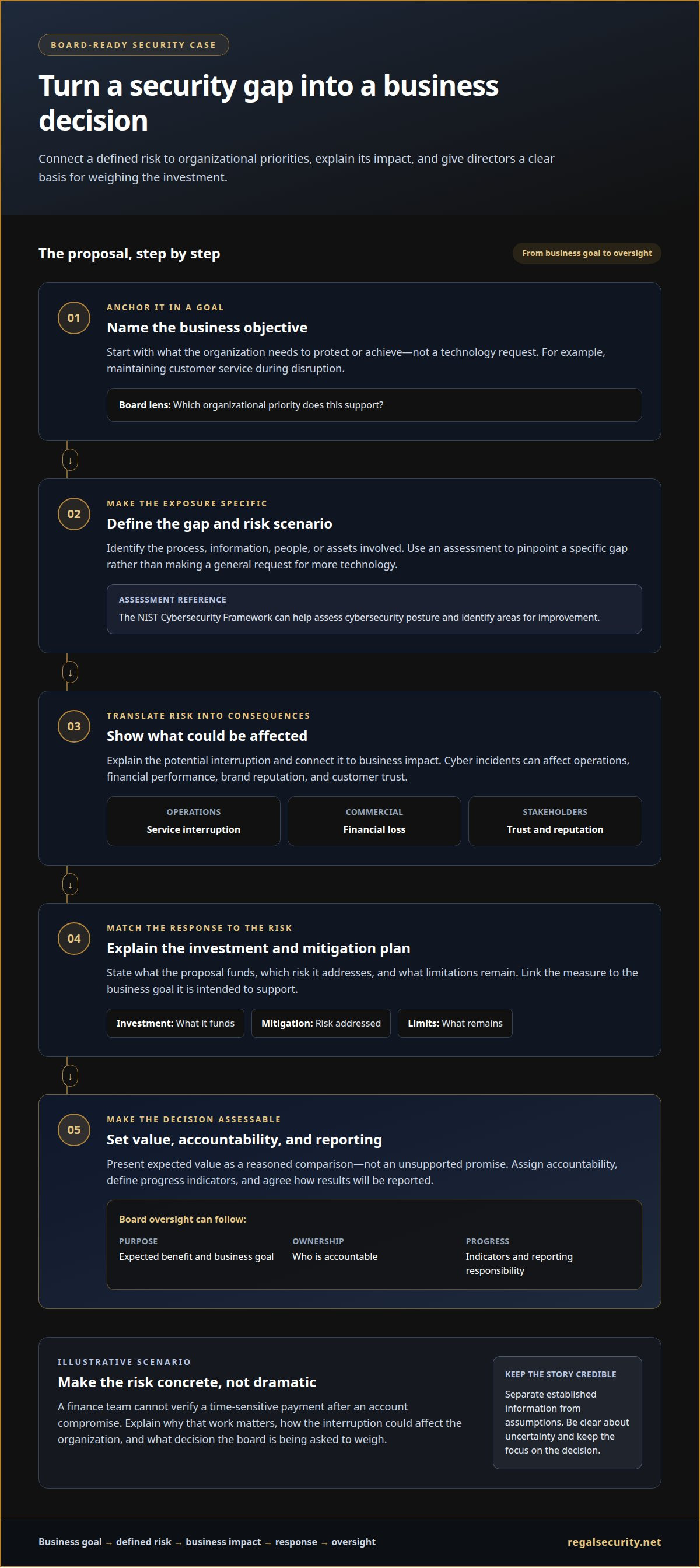
For approval and oversight, define the risk, review the proposed investment and mitigation plan, assign accountability, and agree on how progress will be reported. The board can then assess whether the proposal supports organizational goals and review results as the work proceeds.
Business objective: Name the goal, such as maintaining customer service during disruption.
Risk scenario: Describe a plausible incident and the process, information, or stakeholder it could affect.
Investment and mitigation: Explain what the proposal funds, what risk it addresses, and what limitations remain.
Value and oversight: Set out the expected benefit, progress indicators, and reporting responsibility.
Present ROI as a reasoned comparison, not an unsupported promise. Explain the investment’s purpose, expected value, risks, and mitigation measures. For example, a proposal to strengthen protection for a customer-facing system can link the measure to service continuity and specify how leaders will track implementation. This gives the board a clear basis for weighing the decision against business strategy.
Risk estimates are more useful to executives when they connect a cyber scenario to operational and financial consequences. Cybersecurity risk quantification can translate cyber risks into business impact and create a common language across an organization. Tailor cybersecurity communications to executives’ knowledge and interests, avoid technical jargon, and focus on business impact. Scenarios and simulations can illustrate how a cyberattack could affect organizational priorities.
A board-facing business case should explain anticipated ROI, potential risks, and mitigation strategies, rather than present a technology purchase alone. The NIST Cybersecurity Framework emphasizes integrating cybersecurity into an organization’s overall risk management strategy, allowing leaders to frame a proposal alongside other organizational risks. Nonprofits can estimate the return on a financial technology investment by calculating staff time spent on manual tasks and translating those hours into salary costs. This offers executives a practical basis for comparing costs and expected benefits. Pair the estimate with the scenario, mitigation plan, and uncertainties so oversight stays tied to business outcomes.
2. Communicating proposals through storytelling
A compelling proposal gives board members a sequence they can follow, not a catalogue of technical concerns. Begin with a person, process, or decision the organization depends on. Then show how a plausible security event could interrupt that work, how the organization would respond, and what decision the board must make. For example, describe a finance team unable to verify a time-sensitive payment after an account compromise. This gives abstract exposure a human and operational context without presenting speculation as fact.
Keep the story disciplined. Separate established information from assumptions, and state assumptions plainly. If the scenario depends on a system being unavailable, explain why that system matters to a particular department. Avoid dramatic details that distract from the decision. A credible sequence, from initial event to business consequence and response, gives leaders a sound basis for discussion.
Persuasive communication can combine ethos, pathos, and logos. Ethos establishes the presenter’s credibility through clear ownership of the analysis and candid acknowledgment of uncertainty. Pathos connects the issue to people affected by disruption, such as employees serving customers. Logos provides the evidence, reasoning, and decision criteria. Used together, these techniques make the case compelling without relying on fear or overstated claims.
Ethos: Identify who prepared the assessment and who will oversee the proposed work.
Pathos: Describe how an interruption could affect employees, customers, or an essential service.
Logos: Present the supporting evidence, proposed response, and basis for evaluating progress.
Shape the narrative around the board’s decision, not the presenter’s technical process. A concise sequence can explain the current condition, the credible scenario, the organizational consequence, and the requested action. For instance, a proposal could show how delayed access to a core business application affects staff decisions, then explain which safeguards would reduce that exposure. The example should clarify the choice, not imply that a particular event is inevitable.
Close by making the decision explicit. State what approval enables, what risks remain, and how leaders will receive updates. If the board must choose between phased implementation and a broader rollout, explain the trade-offs in operational terms. Invite focused questions about assumptions, accountability, and expected outcomes. This turns a security presentation into a structured conversation, allowing directors to test the reasoning and understand the consequences of their decision.
Keep the three appeals in balance throughout the narrative. Ethos helps establish why the recommendation merits consideration, while pathos makes its human implications understandable. Logos gives the board a way to examine the reasoning and weigh the requested action. The article describes ethos, pathos, and logos as three techniques for persuasion and recommends combining them in strong arguments. Each should reinforce the same decision rather than pull the discussion in a different direction. A human example should connect to the evidence, and the evidence should support the requested action. Credibility also depends on being clear about what is known and what remains uncertain. When these elements work together, the proposal can be persuasive while leaving room for scrutiny, questions, and a measured board response.
3. Developing relationships and advocates among board members
Board support is often shaped before a formal meeting through focused conversations with individual directors. Start by learning each member’s responsibilities, experience, and priorities. A director with finance experience may want to understand how a proposal affects risk oversight. A director focused on operations may ask how security measures affect staff workflows. Use these conversations to identify the concerns the board will expect the proposal to address.
Prepare for each discussion instead of delivering the same presentation repeatedly. Ask which outcomes matter most to that director, then connect security priorities to those outcomes. For example, if a board member is focused on customer retention, explain how an interruption could affect customer-facing operations. If another prioritizes continuity, discuss the business processes that need dependable access. These tailored conversations help you anticipate questions.
Listen closely to objections and record their substance. A concern about operational disruption calls for a clear account of implementation effects. A question about accountability calls for defined ownership and reporting. Respond with relevant information, not pressure. If an issue needs further analysis, agree on the specific point to resolve and provide a direct answer before the board discussion.
Map priorities: Note each director’s principal business interests and relevant expertise.
Invite questions: Ask what evidence or decision criteria would make the proposal easier to assess.
Address concerns: Match each objection with a practical response, such as an implementation plan or clear accountability.
Request advocacy: Ask a supportive director to clarify the board’s concerns or help frame the discussion, without asking them to endorse unsupported claims.
An effective advocate does more than repeat the presenter’s argument. They can explain why the issue matters to the board’s responsibilities and identify questions worth addressing. For instance, a director who understands operational dependencies may help colleagues see why a proposed safeguard supports continuity. Give that advocate concise, consistent information so their contribution remains accurate and aligned with the proposal.
Keep relationships active after the decision. Provide progress updates in the format and cadence agreed with board members, and be direct about delays, changes, or unresolved issues. If an initiative is underperforming, explain the cause and corrective action. Transparent follow-through supports confidence, gives advocates reliable information, and makes further security investment a considered governance discussion rather than a once-a-year request.
4. Presenting clear visuals and concise information
A board presentation should make the decision clear before technical detail competes for attention. Use one central visual to show the relationship between a business asset, its exposure, and the proposed security measure. For example, a simple flow diagram can connect a customer portal, the teams that rely on it, and the business consequences of an interruption. This gives directors a shared reference point for the discussion.
Choose a chart only when it clarifies a specific comparison. A risk matrix can distinguish high-priority exposures from lower-priority concerns, while a timeline can show implementation stages and decision points. Label axes, categories, and assumptions in plain language. If a chart presents likelihood and impact, explain what each rating means so directors interpret the visual consistently.
Concise information should not omit important context. Present the recommendation, rationale, principal risks, and oversight approach in a consistent sequence. A one-page summary can state the decision required, while supporting material provides technical definitions and detailed analysis. This lets board members understand the central argument first and consult more detail when needed.
Lead with the decision: State what approval enables and identify the business objective it supports.
Show the connection: Use a diagram or chart to link an asset, exposure, and proposed safeguard.
Explain the evidence: Define categories, assumptions, and relevant time periods directly beside the visual.
Separate detail: Keep the main presentation focused and place technical material in supporting pages.
For a proposal addressing access to a critical business application, a concise dashboard could show its importance, the identified exposure, the planned control, and who is responsible for tracking progress. Use brief labels such as “service availability” instead of unexplained technical shorthand. A clear legend and consistent color meanings help the board interpret the information without relying on a presenter to explain every element.
Visuals should clarify, not manufacture certainty. Avoid decorative graphics, dramatic imagery, or color coding that implies unsupported precision. If the assessment uses qualitative categories, name them and describe the evidence behind each placement. State unresolved questions plainly, then explain how they affect the recommendation. This gives directors a reliable basis for scrutiny and builds trust in the analysis.
Before the meeting, review the presentation from a board member’s perspective. Check that each page answers a decision-relevant question, terms are consistent, and the requested action is easy to find. During the discussion, pause at the key visual and invite questions about its assumptions. A concise, legible presentation helps leaders examine the proposal and focus on the decision.
5. Building a value proposition aligned with organizational goals
A value proposition explains why a security investment matters to the organization’s future, not just its current exposure. Start with a stated strategic goal, such as protecting shareholder value, maintaining customer confidence, or sustaining critical operations. Then connect the proposed investment to the people, assets, and processes that support that goal. This helps directors judge the proposal by its contribution to organizational priorities.
Make the connection specific. If an organization’s strategy depends on reliable customer service, identify which operations a security incident could affect. Explain how the proposal addresses that exposure and which business outcome it is intended to support. Distinguish the intended benefit from a guaranteed result so directors have a credible basis for evaluating the investment.
Support the value proposition with evidence relevant to the decision. Industry benchmarks can provide context for how an organization’s approach compares with relevant practices, while competitive analysis can show how security supports its position. Key performance indicators can track implementation and outcomes. Choose indicators directly related to the proposal, such as completion of planned safeguards or progress in addressing a defined risk, rather than metrics that look impressive but do not inform board oversight.
Strategic goal: Identify the organizational objective the investment supports.
Critical dependency: Name the asset, service, or process that enables that objective.
Evidence: Use relevant benchmarks, competitive analysis, and indicators to substantiate the case.
Accountability: Identify who will report progress and how results will inform future decisions.
Use a tabletop exercise or real-time simulation to make potential business effects easier to assess. For example, a scenario involving disruption to a critical business asset can prompt directors to consider operational dependencies, decision responsibilities, and response options. The exercise is not a prediction. It is a structured way to assess whether the proposed investment addresses organizational needs and whether leaders understand their roles.
Present trade-offs openly. Explain what the investment addresses, which risks remain, and how the organization will monitor progress. If proposing a phased approach, show how each phase supports the larger objective and what evidence will guide the next decision. This gives board members a clear view of value, limits, and oversight instead of relying on a broad promise of protection.
For organizations assessing how on-site security support fits their operational goals, consider security support for critical operations as part of the value discussion.
Regal Security
Regal Security helps organizations address on-site security needs in corporate, residential, and executive settings. When a board-approved plan calls for a reliable on-site presence, Unarmed Security Officers, Concierge Services, and Vehicle Patrol can support operational priorities. Executive Protection can address security planning for executives.
These services can form part of a broader investment case when the identified need involves people, premises, or executive safety. They are distinct from cybersecurity measures, so the proposal should match the investment to the risk it is intended to address. For an on-site security requirement, contact Regal Security to discuss the needs your organization has identified.
Turn board approval into deliberate action
Once directors agree on a security priority, connect the decision to the work that follows. Clarify who owns the next step, how progress will be communicated, and when the board will review whether the initiative remains aligned with organizational needs. This continuity turns approval into responsible oversight rather than a one-time vote.
A persuasive case for how to convince your board to invest in security also depends on matching the response to the risk. Cybersecurity controls address digital threats, while on-site security support addresses different operational needs. If your board’s plan includes strengthening on-site protection, contact Regal Security to discuss how its services fit those requirements.
Contact Regal Security to discuss your needs and consider the appropriate next step for your organization. A clear decision today can support a more thoughtful, well-directed security plan tomorrow.