Special event security planning: How many guards do you need
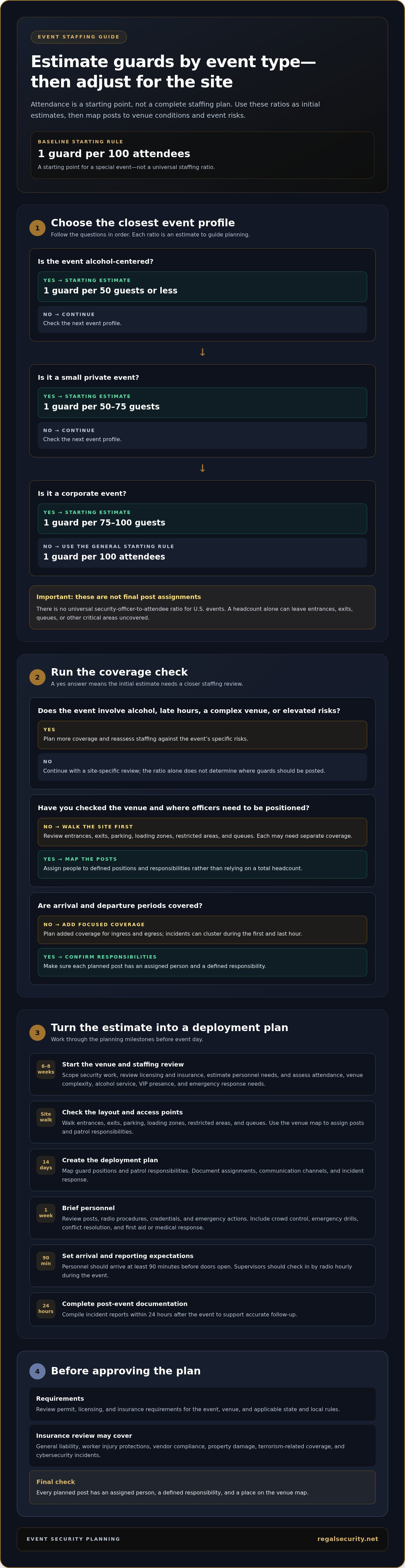
A headcount is a starting point, not a complete staffing plan. A special event security planning checklist can use one guard per 100 attendees as a minimum starting rule, with more guards for events involving alcohol or late hours; a small private event may call for one per 50-75 guests, while an alcohol-centered event may need one per 50 guests or less. The right estimate also depends on the venue, access points, event risks, and where officers need to be positioned.
It’s reasonable to want a clear number before committing to an event security plan. But staffing based on attendance alone can leave entrances, exits, queues, or other critical areas uncovered. A useful estimate accounts for guest numbers alongside the event’s specific conditions.
This guide explains how to estimate guard staffing, assess venue and crowd risks, plan accessible exits, and coordinate roles with emergency responders. It also shows how to tailor security arrangements to the event, so your plan is practical, measured, and ready to guide staff before the doors open.
Table of Contents
Event Security Staffing Ratios: How Many Guards Do You Need?
There is no universal security-officer-to-attendee ratio for U.S. events. A special event security planning checklist can start with one guard per 100 attendees, with more coverage for alcohol, late hours, complex venues, or elevated risks. Small private events may use one guard per 50-75 guests; corporate events, one per 75-100 guests; alcohol-centered events, one per 50 guests or less.
Permit, licensing, and insurance requirements depend on the event, venue, and applicable state and local rules. Review them before approving the plan. An insurance review may cover general liability, worker injury protections, vendor compliance, property damage, terrorism-related coverage, and cybersecurity incidents.
Use a special event security planning checklist to turn staffing estimates into a site-specific deployment plan:
Start the venue and staffing review six to eight weeks out. This allows time to scope security work, review licensing and insurance, and estimate personnel needs.
Walk the site before setting posts. Check entrances, exits, parking, loading zones, restricted areas, and queues, since each may need separate coverage.
Complete a risk assessment. Consider attendance, venue complexity, alcohol service, VIP presence, and emergency response needs before settling the roster.
Map posts before assigning personnel. A headcount alone can leave officers without specific positions or responsibilities.
Create the deployment plan 14 days before the event. Assign guard positions and patrol responsibilities against the venue map.
Plan added coverage for arrival and departure. Staff ingress and egress more heavily because incidents can cluster during the first and last hour.
Confirm staff and volunteer roles. Assign responsibility for access, communications, restricted areas, emergency exits, and incident reporting.
Brief personnel one week before the event. Review posts, radio procedures, credentials, and emergency actions. Include training in crowd control, emergency drills, conflict resolution, and first aid or medical response.
Set arrival and reporting expectations. Personnel should arrive at least 90 minutes before doors open; supervisors should check in by radio hourly during the event.
Plan post-event documentation. Compile incident reports within 24 hours after the event to support accurate follow-up.
Use the special event security planning checklist to confirm that every planned post has an assigned person and a defined responsibility. Document assignments, communication channels, and incident response so staffing decisions reflect venue conditions, risks, and evacuation responsibilities.
Accessible egress for attendees with disabilities
Plan attendee movement in both directions: arrival and evacuation. An entry route can become obstructed later by queues, vendor equipment, or crowd movement. Before operations begin, map accessible routes, exits, and assistance arrangements. Walk each route with the venue team, noting doors, turns, level changes, and places where guests may need help.
Map primary and secondary evacuation routes. Mark accessible routes and exits on the event plan so staff can direct attendees without relying on verbal descriptions alone.
Keep exit paths clear throughout operations. Assign someone to watch for chairs, signs, cables, or vendor items blocking routes, because an obstruction can change how attendees leave.
Define assistance roles in advance. Identify who will communicate with an attendee requesting help, who will coordinate movement, and how that information reaches the event lead.
Plan for different mobility needs. Review the route with the venue team and consider how it works for wheelchair users, people using mobility aids, and guests who move more slowly.
Include accessible egress in staff briefings. Show personnel the mapped routes and explain where to direct guests if an exit becomes unavailable.
Recheck the routes after setup. Walk them again once barriers, furniture, temporary structures, and vendor equipment are in place.
Entry planning also affects safe exit. Document every entrance, the guest screening process, and who is responsible for access control. If the event uses bag checks or searches, make the process lawful, clearly posted, and professional. Tell guests about screening in advance so they know what to expect before reaching the entrance.
Manage queues without narrowing accessible paths or blocking exits. Mark queue boundaries and chokepoints on the layout, then assign staff to observe crowd movement. Track capacity using everyone on site, including admitted guests, staff, and security personnel, rather than guest attendance alone. If a line begins to spill into an evacuation route, staff should know who can adjust it and communicate the change.
Coordinate vendors and venue personnel through a shared access plan. Record delivery routes, loading zones, restricted areas, and setup times, then identify the paths that must stay clear. Catering carts, cable cases, and temporary signs can obstruct routes when vendor access is not coordinated. Confirm who can move equipment and who reports blocked passages during the event.
Accessible egress should remain part of the plan after doors open, not just during setup. A designated staff member can monitor key routes as attendance and crowd movement change. A clearly mapped on-site security presence can support route monitoring and orderly guest movement.
Event risk assessment
Begin a site-specific assessment at least 30 days before the event. Review the venue, event profile, expected attendance, and nearby activity together. A concert near busy transit presents different concerns than a private indoor reception. Record the findings so they can shape site access, staffing, and emergency actions.
Schedule a venue walk and map posts, checkpoints, and exits three to four weeks before the event. Inspect entrances, exits, blind spots, perimeter gaps, parking, loading zones, restrooms, restricted areas, and queue locations. Note how vendors, vehicles, and guests will move through each space, and compare the planned layout with the venue’s normal operations.
Review prior incidents involving similar events. Past issues can point to locations or situations that deserve closer attention during the current assessment.
Consider visibility and threat exposure. Public promotion, political or social sensitivities, and nearby infrastructure can affect how an event is exposed.
Assess attendance and attendee profiles. Expected crowd size and event format influence movement, access needs, and the monitoring required at gathering points.
Identify alcohol-related concerns. Alcohol can make crowd management more difficult, so account for service areas, queues, and how guests move between spaces.
Include weather and environmental hazards. For an outdoor event, consider how rain or other severe weather could affect the layout and evacuation routes.
Inspect vehicle and service access. Review parking, loading docks, delivery paths, and perimeter access for potential conflicts with guest movement.
Check venue safety conditions. Verify exit signage, emergency lighting, backup power, fire suppression readiness, and clear evacuation pathways.
Turn each finding into a practical control. If a blind spot overlooks a queue, place a staff post where it can observe the area. If parking crosses a pedestrian route, separate the paths on the layout. If weather could affect an outdoor gathering, document how the event team will respond and who makes that decision.
Keep the risk assessment specific to the event. A review of one venue is not automatically suitable for every gathering. Changes to attendance, alcohol service, access points, or event timing can alter the risks. Update the plan when details change and record who owns each action. Clear reporting helps event leads track unresolved concerns and brief personnel on adjustments before operations begin.
How should event security coordinate with police and first responders?
Build coordination around defined roles, clear contacts, and a shared response plan. Before event day, identify who leads security decisions, who contacts public agencies, and how officers report incidents. A private event with a public entrance may need different coordination from one with restricted access. Assign responsibilities to match the event profile and likely emergency scenarios.
Where can organizers find local event security requirements and contacts? Start with the venue, then consult the city or county offices responsible for event permits and public safety. Contact local law enforcement and emergency services to establish appropriate coordination for the location and event.
Record the following details in one accessible plan, then share relevant information with event leads and responders:
Name the decision lead. Assign one person to coordinate security actions and communicate changes, so event staff and responders receive consistent direction.
Document emergency contacts and roles. Include the event lead, venue contact, law enforcement liaison, fire services, and EMS contacts, with each person’s responsibility clearly stated.
Set escalation steps. Define which incidents guards handle within their assigned role and when they notify supervisors or public agencies.
Choose one person to call 911. This avoids duplicate calls and gives dispatch a clear point of contact for location details and updates.
Agree on communication channels. Establish how event personnel, venue staff, and responding agencies will exchange urgent information, including a backup method if the primary channel fails.
Coordinate medical response. For events with more than 1,000 attendees, the checklist recommends notifying EMS or arranging ambulance standby.
Review agency roles before opening. Discuss where responders should enter, who meets them, and how guards will direct them to the incident.
Coordinate with local law enforcement in advance and establish how security personnel escalate incidents to public agencies. For large-scale operations, FEMA and DHS coordination frameworks can help organizers structure interagency planning. A planning meeting can clarify responsibilities while preserving the distinction between private security and public responders.
Test the process before guests arrive. Walk through a medical emergency, severe weather alert, or evacuation with event leads and venue representatives. Confirm who gives instructions, who contacts responders, and which routes remain available. Record any changes to the response plan and brief officers before operations begin. After the event, use incident reports to identify coordination gaps and inform future planning.
Event-specific security planning
VIP events call for a site walkthrough that accounts for the guest’s security detail and movement. For events serving alcohol, plan for busier crowd management and possible incidents around service areas. Higher-risk events may use metal detectors or bag scanners to screen for weapons, explosives, or prohibited items.
Build the event security plan around the event’s profile, not a generic template. A private reception, outdoor festival, and public-facing corporate event each create different access patterns. Match coverage to attendance, public access, late hours, alcohol service, prior problems, and venue layout. Coordinate security posts with crowd movement and emergency procedures.
Define who may enter and who checks access. Clear responsibility prevents uncertainty at entrances, credential points, and restricted areas.
Tailor screening to the event’s risk. If bag checks or searches are used, make the process lawful, clearly posted, and professional, then tell guests beforehand.
Plan crowd flows by activity. Map entry, check-in, queues, chokepoints, exits, and emergency movement routes because each can create different pressure points.
Set procedures for likely incidents. Include lost persons, medical events, aggressive behavior, severe weather, fire alarms, utility failures, and suspicious packages.
Document primary and secondary evacuation routes. Identify assembly locations and transportation coordination so staff can direct guests if the main route becomes unusable.
Assign visible coverage to key locations. Place personnel where they can observe entrances, restricted areas, and crowd-density points without obstructing guest movement.
Identify a decision-maker for changing conditions. For an outdoor event, specify who activates the rain plan and when that decision will be made.
Keep backup personnel within 30 minutes. This provides a planned response if staffing needs change during event operations.
Test the plan before major operations. A tabletop exercise 72 hours before the event can reveal unclear roles, communication gaps, or evacuation problems.
For higher-risk events, coordinate screening, access rules, and escalation procedures with the relevant public agencies. Keep the plan practical: every officer should know their post, reporting path, and response to an incident. Account for guest departure, lingering attendees, vendor breakdown, equipment protection, and the final venue sweep.
For event-specific planning and on-site coverage, discuss security arrangements suited to your event’s needs.
Regal Security: Unarmed Security Officers
Regal Security provides Unarmed Security Officers for event coverage tailored to your venue, guest access, and planned posts. Officers can provide an on-site presence at entrances or designated areas, supporting organizers as they carry out the security plan. When guest reception and security need to work together, Regal Security’s Concierge Services can also support the event.
Consider Regal Security when your staffing plan calls for professional on-site officers or coordinated guest-facing support. Share the event format, venue layout, access requirements, and responsibilities to establish a practical scope.
Contact Regal Security to discuss security support for your event.
Put Your Event Plan Into Motion
A considered security plan should guide decisions as the event takes shape, not remain a document on a desk. Use your special event security planning checklist to align venue operations, guest experience, and security responsibilities, then share the final arrangements with the people carrying them out. Clear handoffs help keep each role understood as details change.
Regal Security offers Unarmed Security Officers, Concierge Services, and Vehicle Patrol to support event security. The right combination depends on the setting and the responsibilities you need covered. Share your event format, venue details, and priorities so the next steps reflect the occasion.
Discuss your event with Regal Security and take the next step toward a well-coordinated event.
Frequently Asked Questions
Event Security Plan Template: What Should It Include?
A practical template connects event details to decisions staff must make. Include the schedule, venue map, responsible leads, assigned posts, communication methods, emergency contacts, evacuation information, and incident-reporting process. Add a revision date and name the person authorized to update the document. For events in New York City, Manhattan, Brooklyn, Queens, the Bronx, Staten Island, Long Island, Nassau County, Suffolk County, Westchester County, Rockland County, Orange County, or New Jersey, record venue-specific contacts and procedures.
How do security officers report incidents during a large event?
Officers should use the event’s agreed reporting channel and provide concise, observable details. A useful report states the location, time, people or property involved, what the officer observed, and what action followed. For example, “north entrance, queue dispute, supervisor notified” is clearer than a broad description. The event lead can direct follow-up, preserve the report, and share relevant information with responders without spreading unverified details.
Incident Response: What Happens When Something Goes Wrong?
The response follows the event’s planned roles: personnel report the incident, the designated lead coordinates the next action, and emergency services are contacted when needed. For example, after a medical emergency, staff can keep the route clear while the designated contact calls 911 and guides responders to the location. Once immediate actions are underway, record key decisions and handoffs so the event team can review what happened accurately.
What should a pre-event venue inspection cover?
A useful inspection compares the approved floor plan with the venue as prepared for the event. Walk the guest journey from arrival through check-in, event spaces, amenities, and departure. Note obstructed doors, temporary structures that alter sightlines, unexpected vendor storage, and changes to planned routes. Record each issue with its location and a responsible person, then revisit unresolved items before guests arrive.
Which Events Require Special Security?
Security planning should reflect the event’s risk profile, not just its label. Public access, alcohol service, late hours, VIP attendance, prior problems, and complex venues can all affect the plan. A private gathering may also need defined security arrangements if guests require screening, parking creates access concerns, or attendees enter private property. The practical test is whether the risks call for assigned responsibilities and controlled access.
What information should be included in a special event security plan?
Include the information each role needs to act without guessing: who is authorized to enter, how credentials are handled, who can change event procedures, and how staff receive updates. Add relevant contingency actions for severe weather, utility failures, suspicious packages, and other scenarios. Identify where revised instructions are recorded and how they reach personnel. A plan is more useful when staff can quickly find current instructions during operations.
How do you assess security risks for a special event?
Start by listing plausible hazards for the event and venue. Consider who or what could be affected and which controls already address each concern. For example, note a crowded arrival area, its potential effect on guest movement, and the measures assigned to manage it. Give every unresolved concern an owner and a next action. Revisit the assessment when the layout, access arrangements, or expected attendance changes.
How many security guards are needed per attendee at an event?
There is no universal guard-to-attendee ratio. A planning starting point is one guard per 100 attendees; small private events may use one per 50-75 guests, corporate events one per 75-100 guests, and alcohol-centered events one per 50 guests or less. These estimates are not a substitute for post assignments. Venue layout, entry and exit points, event risks, and coverage needs shape the final deployment.