School Security Guard Services in the Bronx: What They Cost
A school security budget depends on the coverage a campus needs, not on one universal rate. The cost of school security guard services in the Bronx varies with coverage hours, staffing, access-control duties, patrols, and coordination with school leadership. A quote reflects the school’s specific requirements.
It’s reasonable to want a clear figure before planning, but a useful estimate must account for the school’s daily operations and security priorities. This article explains how those needs shape service scope and what to consider when assessing a tailored plan.
You’ll learn how visitor management, patrol coverage, leadership coordination, and emergency readiness affect the scope of service. The following sections explain how to evaluate whether a security plan fits a Bronx school’s needs.
Table of Contents
Access control and visitor management
In New York City schools, security guards can help manage entry, observe visitor movement and campus activity, and report concerns. Daily duties may include directing visitors to the main office, supporting established arrival procedures, and notifying school staff when an entry issue arises.
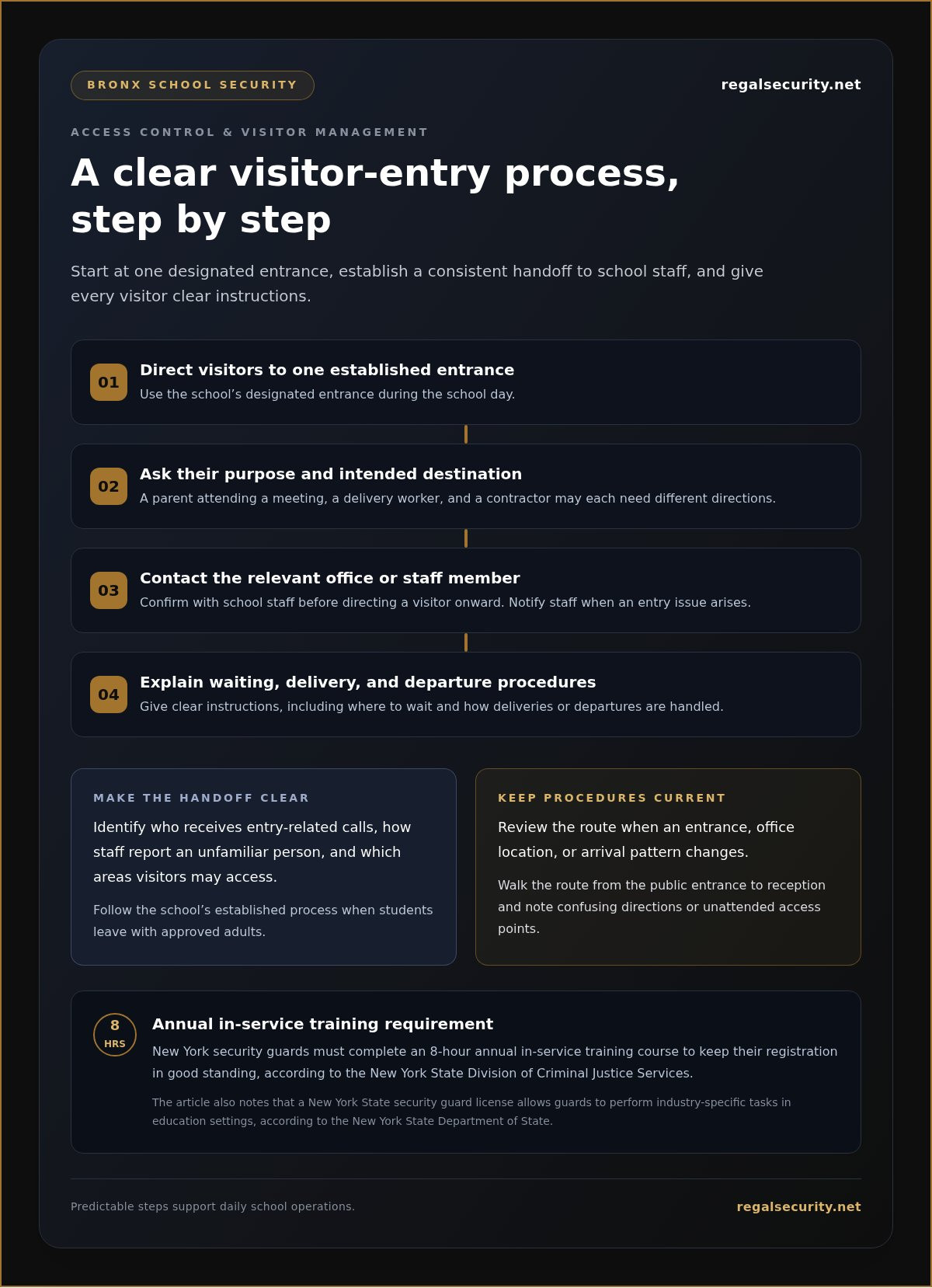
A clear visitor process starts at the designated entrance. School leaders can establish who may enter, which office receives guests, and how staff handle deliveries or unexpected arrivals. For example, a visitor arriving during morning drop-off can be directed to the office rather than left to navigate student areas. Consistent steps help distinguish routine arrivals from situations that need staff attention.
Training supports those responsibilities. New York security guards must complete an 8-hour annual in-service training course to keep their registration in good standing, according to the New York State Division of Criminal Justice Services. Regal Security personnel are thoroughly prepared to handle these duties effectively. A New York State security guard license allows guards to perform industry-specific tasks in education settings, according to the New York State Department of State.
For practical access control, school leaders can document a straightforward arrival sequence:
Direct visitors to one established entrance during the school day.
Ask each visitor to state their purpose and intended destination.
Contact the relevant office or staff member before directing the visitor onward.
Provide clear instructions for waiting, deliveries, and departures.
These steps make the process predictable without treating every visitor as a threat. A parent attending a scheduled meeting, a delivery worker, and a contractor each have different destinations. A guard who understands the school’s procedures can direct each person appropriately and alert staff if a visit differs from the expected plan.
Visitor management also relies on communication. School leadership should identify who receives entry-related calls, how staff report an unfamiliar person, and which areas visitors may access. A concise contact list and clear handoff process can reduce confusion when the office is busy or someone arrives during dismissal. Procedures should also account for students leaving with approved adults, following the school’s established release process rather than informal assumptions.
Review the process whenever school routines change, such as when an entrance or office location changes, or arrival patterns shift. Walk the route from the public entrance to reception and note confusing directions or unattended access points. This practical review helps leaders refine duties and decide whether an unarmed guard’s visible presence or a concierge-style welcome better supports visitor flow.
Campus patrols
A patrol plan should reflect the school’s layout and daily routines. Start with a campus map that marks entrances, exterior doors, playgrounds, parking areas, and dismissal locations. Then identify where staff need a visible presence, such as a delivery entrance or a walkway students use after classes. The goal is consistent observation and timely reporting along a defined route.
School leaders can divide the site into practical patrol zones. One route might connect the main entrance, outdoor recreation area, and perimeter doors; another might cover a parking area and the route to an assembly space. The path depends on buildings, sightlines, and student movement. Mark locations on the map so the officer can follow the plan and report which areas were covered.
Set patrol timing around activity, not an arbitrary schedule. Identify periods when arrival, class transitions, lunch, dismissal, or evening events change how people use the grounds. For example, a patrol near a playground may be more useful during outdoor activity, while the dismissal route needs attention as students leave. Record routine changes, such as a relocated pickup point, and adjust the plan accordingly.
A useful patrol procedure sets out clear steps:
Review the route and priority locations with the school’s designated contact.
Observe doors, walkways, and shared spaces for conditions that need attention.
Report an unsecured entrance or blocked route through the school’s agreed process.
Document relevant observations, including the location and action taken.
Pass unresolved concerns to the appropriate school staff member.
Reporting makes a patrol an operational tool. A note that says “door issue” gives staff little direction. A useful entry identifies the west-side entrance, explains that it did not close properly, and states who received the report. School leaders can track recurring maintenance concerns and distinguish them from unusual activity. Keep records to observable details, not assumptions about someone’s intent.
Review the route when the campus changes. Construction, a relocated playground, or a new dismissal arrangement can make an old patrol map misleading. Walk the route with a school representative and mark changes before assigning coverage. Schools considering how campus patrol planning fits their routines can use these mapped priorities to frame the discussion. A defined route, clear reporting steps, and regular review make patrol duties easier to understand and coordinate.
Coordination with school leadership
A school security plan works best when guards know who makes decisions. The principal, office staff, facilities personnel, and assigned guard have distinct responsibilities. School leaders should name the person who receives routine updates and the administrator who handles urgent concerns. If a guard notices a damaged exterior door, for example, they need a clear reporting contact.
Start with a written duty outline describing the guard’s post, expected observations, communication channels, and limits of authority. School leadership can clarify how staff handle student discipline, parent concerns, and access requests. A guard can report an observed concern, while school staff determine the appropriate educational or administrative response. Clear boundaries help prevent conflicting instructions during a busy school day.
Briefings connect the written plan to current campus activity. Before a schedule change, the principal or designated contact can explain affected entrances, event locations, and staff responsibilities. An assembly, parent meeting, or construction project may change the usual flow. Sharing these details helps the guard adjust their position and relay observations to the right staff member.
Agree on practical communication steps before coverage begins:
Name the school contact for routine updates and the administrator for urgent reports.
Choose an approved method for communicating during arrival, dismissal, and school events.
Set a process for relaying concerns that require facilities or administrative attention.
Identify who records and reviews incident reports within the school.
Explain how substitute staff receive information about current procedures.
Consistent reporting gives school leaders useful context. A concise report identifies the location, observed condition, time, and person notified. For example, “north hallway, water on floor, facilities contact notified” is more actionable than “hallway issue.” Keep observations factual and avoid conclusions about intent. Administrators can then decide whether to address maintenance, follow up with staff, or take another appropriate step.
Privacy also requires shared expectations. School leaders should explain what information belongs in a report, who may receive it, and how to handle sensitive student matters. If a guard hears a parent raise a concern, they can direct that person to the appropriate school office instead of discussing student details. This keeps security observations distinct from educational decisions.
Review coordination after schedule or staffing changes. The principal can confirm that contact names, event instructions, and reporting procedures remain current. A brief handoff between school staff and the guard helps prevent outdated directions from carrying into a new routine. Defined responsibilities and direct communication help school leadership keep security activity responsive without disrupting daily work.
Customized school security plans
A sound plan matches staffing and procedures to the school’s setting, schedule, and responsibilities. Bronx schools can use these criteria to define an appropriate scope.
Guard Roles, Qualifications, and Screening
School security guards, school safety agents, and off-duty NYPD officers are distinct staffing options. Compare their assigned duties, authority, supervision, and communication with school administrators before choosing a role. The school’s operational needs, not job titles alone, should guide the decision.
New York security guards must complete an 8-hour annual in-service training course to keep their registration in good standing, according to the New York State Division of Criminal Justice Services. Guards must complete 16 hours of on-the-job training within 90 days of starting work and an 8-hour annual in-service course to keep registration in good standing.
For background checks and fingerprinting, establish a documented screening process before assigning personnel to a school. Clarify who handles each step, how completion is recorded, and who receives updates. Public and private schools should distinguish their school-specific procedures from state guard-registration requirements when setting written rules.
Choosing a Bronx School Security Company
Bronx schools can assess security providers by how clearly they describe education-setting duties, communicate with school leadership, and follow a written site plan. Define a scope covering post responsibilities, reporting lines, schedule changes, and incident documentation. These details help administrators judge whether an approach fits their campus.
Assess a proposed contract for insurance provisions, incident-reporting responsibilities, and procedures for addressing concerns. Schools should also look for operational risks, including unclear authority, inconsistent handoffs, or patrol duties that do not match campus activity.
Hiring and Contracting Security Services
To contract services, document the school’s coverage needs, priority locations, staff contacts, and daily routines. Then put duties, supervision, communication methods, reporting expectations, and contract terms in writing. A campus walkthrough helps administrators explain site conditions and align proposed responsibilities with school operations.
Bronx schools can reduce avoidable confusion by naming a school contact, setting a process for schedule changes, and assigning staff to review reports. For example, the contract can specify how a guard reports an unsecured entrance and which administrator receives the information. These steps address operational risks while keeping school decisions with school leadership.
Emergency response readiness
A written response plan should tell school staff what to do, whom to notify, and where to direct people. If a student becomes ill in a hallway, for example, staff need a clear way to contact the school office and guide others around the area. The guard’s role should support the plan and follow school leadership’s instructions.
Begin by identifying the situations the school’s procedures should address. A Bronx campus might plan for a medical concern, a disruptive visitor, a building problem, or an evacuation. For each scenario, define who makes decisions, how staff communicate, and which exits or gathering locations matter. Keep instructions specific to the school’s layout and daily routines.
Write a simple sequence for communicating an urgent concern. Staff should know the primary school contact, the backup contact, and what details to report. A concise message can state the location, the observed issue, and whether anyone needs immediate assistance. The guard should follow the school’s established escalation process rather than make decisions outside assigned responsibilities.
Identify the person who directs the school’s response.
Share the approved communication method with staff and security personnel.
State which locations or routes are affected by the incident.
Follow the school’s instructions for guiding students and visitors.
Record the observation and report it through the designated channel.
Use an evacuation as a planning example. School leaders can mark exits, accessible routes, and an outdoor meeting location on a campus map. Staff should understand who guides students, who checks assigned areas, and who communicates with responders. A guard can assist within the school’s procedure, such as directing visitors away from a restricted route, while administrators coordinate school decisions.
Practice should test whether instructions work in real spaces. A walk-through may reveal that a hallway sign is hard to see, a meeting point conflicts with dismissal, or a contact list names someone no longer assigned to the school. Update the written plan afterward and share changes with the people who need them. Keep sensitive details limited to appropriate staff.
Emergency readiness also depends on clear handoffs. After an incident, the school’s designated contact can gather relevant observations, identify unresolved issues, and revise procedures as needed. If staff receive conflicting directions during a building disruption, for example, leadership can clarify the communication chain before the next school event. A calm, defined process helps people act with purpose rather than guess.
For a school planning an on-site security presence, discuss school security needs in relation to its response procedures and campus routines.
Regal Security: Unarmed Security Officers
Regal Security provides Unarmed Security Officers for organizations seeking a professional on-site presence. For a school, officers can support duties such as maintaining an orderly post, observing campus activity, and communicating concerns through school leadership’s procedures.
Schools can also use Concierge Services when welcoming visitors and directing them through established entry procedures are priorities. The appropriate scope depends on the school’s routines, site layout, and assigned responsibilities. Clearly defined duties help school leaders align the service with operational needs.
To discuss your school’s security priorities and service needs, contact Regal Security or visit regalsecurity.net.
Set a Clear Path for Your School’s Next Step
Before arranging coverage, identify the outcome your school wants from an on-site security presence. Is the priority a composed welcome at the entrance, a visible officer presence, or patrol coverage around campus? A focused discussion can turn broad concerns into a practical service scope.
For schools considering school security guard services in the Bronx, the next step is to match the requested duties to campus routines and leadership’s expectations. Regal Security offers Unarmed Security Officers, Concierge Services, and Vehicle Patrol. These services address different priorities, from a staffed post to mobile coverage, with the scope shaped around the school’s needs.
Prepare a brief outline of your campus priorities, reporting structure, and key routines before beginning that conversation. It gives school leaders a useful foundation for discussing how a security presence could fit their environment. Contact Regal Security to discuss school security and take a considered next step toward a plan that supports your school community.
Frequently Asked Questions
How Much Does It Really Cost, and How Long Does It Take?
The cost and start arrangements depend on the coverage a school needs and the requirements for service. School security guard services in the Bronx may involve a defined post, visitor-facing duties, or patrol coverage, each with different staffing considerations. Outline the schedule, campus priorities, and responsibilities to clarify the scope. Pricing is provided by quote based on those requirements.
What Makes a Security Guard School "the Best" in the Bronx?
The best fit is the service arrangement that meets a school’s priorities and works smoothly with its staff and routines. A campus hosting frequent family meetings, for example, may prioritize a professional welcome and clear visitor direction, while a school with dispersed outdoor areas may value patrol coverage. Consider whether duties are clear, communication is practical, and reports help administrators make informed decisions without disrupting instruction.
What school security guard services are available in the Bronx, NY?
Regal Security offers Unarmed Security Officers, Concierge Services, and Vehicle Patrol. An unarmed officer may suit a school seeking an on-site security presence, while concierge services support a visitor-facing environment. Vehicle Patrol addresses needs for mobile coverage around a property. Regal Security also offers Executive Protection for a different client need. The school’s priorities and assigned duties determine which service is relevant.
How much do school security guard services cost in the Bronx?
Pricing depends on the school’s service requirements and is provided by quote. Cost factors include the number of posts, coverage hours and days, assigned duties, and whether the scope includes visitor-facing work or vehicle patrol. Prepare the school’s operating schedule and describe priority areas before requesting a quote. This helps connect the proposed scope to the campus’s actual needs.
How should schools evaluate and monitor a school security company?
Evaluate a security company against written duties, communication expectations, and the campus’s operational needs. During service, a designated administrator can review whether posts and patrol duties remain appropriate as routines change. Track concerns by type and location, note how they were reported, and discuss recurring issues with the appropriate contact. Repeated confusion during a school event, for example, may indicate a need to clarify staff roles or event procedures.
What New York City and state rules govern security at public and private schools?
New York requires security guard applicants to complete an 8-hour pre-assignment course before applying for registration, and guards must complete 16 hours of on-the-job training within 90 days of starting work. They must also complete an 8-hour annual in-service course to keep their registration in good standing; a New York State security guard license allows guards to perform industry-specific tasks in education settings.