Questions to Ask a Potential Security Provider About Costs
A security proposal is comparable only when its scope, contract terms, and accountability are clear. The questions to ask a potential security provider should cover what the agreement includes, how performance is reviewed, how personnel risks are addressed, and how the provider’s responsibilities fit with your own. The cost depends on the assignment’s scope, service model, staffing requirements, and location. Request a quote to discuss pricing for your needs.
It’s reasonable to look closely at the price, but the fee alone won’t show whether a service matches your needs. Assess the terms behind the proposal, understand what shapes the assignment, and gather the information needed to compare options. Ask about reporting, personnel oversight, risk prevention, and shared security responsibilities so you can make a clearer decision.
Table of Contents
1. Can You Provide Detailed Contract Terms, Transparent Pricing Structures, and Service Agreements?
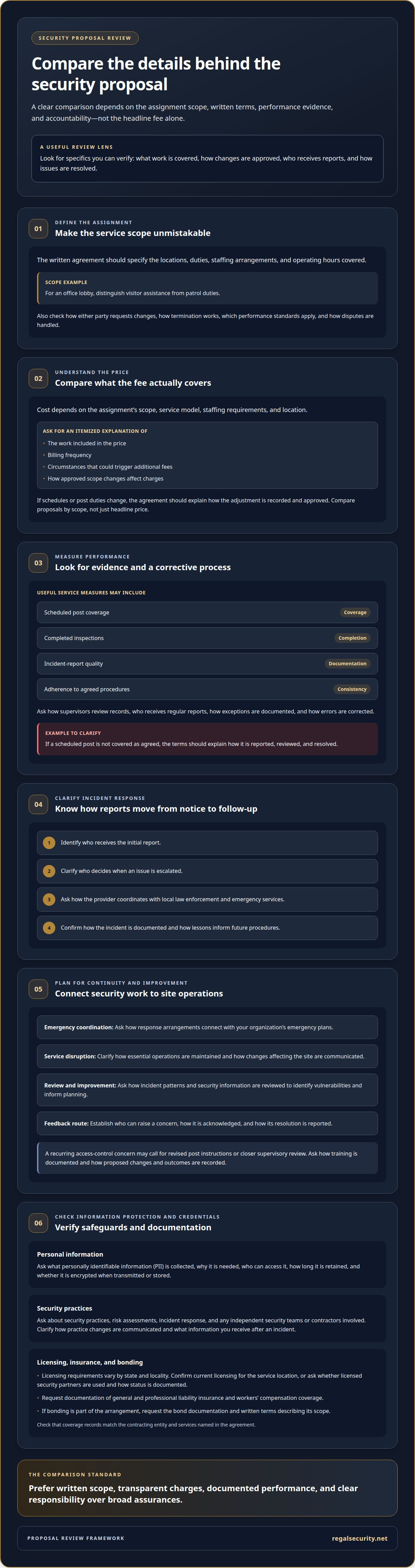
A written agreement should explain the assignment before service begins. Ask which locations, duties, staffing arrangements, and operating hours are covered. For example, an agreement for an office lobby should distinguish visitor assistance from patrol duties. It should also explain how either party requests changes, how termination works, what performance standards apply, and how disputes are handled. Clear terms help prevent misunderstandings.
Ask how the quoted price is determined, not just what the total is. Cost depends on the assignment’s scope, service model, staffing requirements, and location. Request an itemized explanation of the work covered, billing frequency, circumstances that could trigger additional fees, and how approved changes to the scope affect charges. If the schedule or post duties change, for instance, the agreement should explain how the adjustment is recorded and approved. This lets you compare proposals by scope, not just headline price.
Distinguish firm commitments from estimates. Ask which performance measures are contractual, how exceptions are documented, and who receives updates when service conditions change. The agreement should explain reporting responsibilities and how errors are corrected. For example, if a scheduled post is not covered as agreed, the terms should describe how the issue is reported, reviewed, and resolved. Accountability comes from written procedures, not promises of perfection.
Discuss personal information before sharing it. Ask what personally identifiable information (PII) the provider collects, why it is needed, who can access it, and how long it is retained. If information is transmitted or stored, ask whether it is encrypted in both states. The agreement or privacy documentation should explain how information is protected and how relevant practices are communicated to your designated contacts. This matters when service records may include visitor or employee details.
Ask about the provider’s security practices, risk assessments, incident response, and any independent security teams or contractors involved. Find out how changes to these practices are communicated and what information you receive after an incident. A designated contact and reporting route help your organization understand its responsibilities and act on relevant updates.
Licensing varies by state and locality because requirements, training standards, and operational oversight differ across jurisdictions. Ask whether the provider maintains current licenses where it operates or works with licensed security partners, and how that status is documented for the service location.
Ask for documentation of general and professional liability insurance and workers’ compensation coverage. If bonding is part of the proposed arrangement, request the bond documentation and written terms describing its scope. Make sure those records match the contracting entity and services named in the agreement.
2. How Do You Measure Performance and Ensure Continuous Improvement?
Ask how the provider will measure service, document results, and address shortfalls. Useful measures may include scheduled post coverage, completed inspections, incident-report quality, and adherence to agreed procedures. The provider should explain how supervisors review records and who receives regular reports. For example, a missed patrol or incomplete log should be recorded, reviewed, and followed by a clear corrective process, not lost in a general performance summary.
Incident response should be explained as a practical sequence. Ask who receives an initial report, who decides when to escalate, and how the provider coordinates with local law enforcement and emergency services. For example, if a visitor’s concern becomes an urgent safety issue, personnel need to know how to report it, whom to notify, and how to document it afterward. Ask how lessons from incidents inform future procedures.
Discuss how response arrangements connect with your organization’s emergency plans. Ask how the provider handles service disruptions, maintains essential operations, and communicates changes that affect your site. If an incident prevents normal building access, for example, your teams should know who communicates revised arrangements and how security duties adapt. Clear coordination helps prevent conflicting instructions in a demanding situation.
Continuous improvement takes more than a report. Ask how the provider reviews incident patterns and security information to identify vulnerabilities or inform future planning. A recurring access-control concern, for instance, may call for revised post instructions or closer supervisory review. Ask how training is documented and how findings lead to practical changes. The provider should explain how observations lead to action and how it evaluates the result.
Feedback should have a defined route and documented outcome. Establish who can raise a concern, how it is acknowledged, and how the provider reports its resolution. If employees repeatedly describe confusion at a reception point, their feedback may show that instructions or communication need refinement. Ask how client concerns are included in service reviews and how proposed changes are recorded so both parties share the same understanding.
To compare providers, use consistent criteria and ask about experience with organizations similar to yours. Case studies, testimonials, and references can show how a provider has handled comparable needs. Ask what results the examples demonstrate and which practices might apply to your setting. Among the questions to ask a potential security provider, this can reveal whether performance discussions rely on evidence or broad assurances.
Once your priorities are clear, a discussion of security coverage planning can help connect reporting, response expectations, and service needs to the setting being protected.
3. Role segregation and insider-threat prevention
Personnel risk controls begin with knowing who can enter a site, reach sensitive areas, and perform specific duties. Ask how the provider investigates personnel backgrounds and delivers standardized training. Then clarify how responsibilities are separated. For example, an officer monitoring an entrance should not automatically have access to every restricted area. Defined roles limit unnecessary access and make it easier to identify who was responsible for a task or decision.
Ask how access is assigned, recorded, and reviewed. Where digital systems are used, logs should identify users and their access profiles. Physical access also needs clear boundaries, such as designated areas and procedures for visitors or contractors. Ask how access changes when someone’s assignment changes, and how those changes are recorded. A clear process helps prevent former or reassigned personnel from retaining permissions they no longer need.
Separate roles in operational decisions, not just access to doors and systems. Ask who assigns posts, supervises personnel, and reviews incident records. If one person controls every step, errors or misuse may be harder to detect. A documented chain of responsibility lets a supervisor review an officer’s actions and address concerns through an established process. This supports accountability without treating every employee as a threat.
Risk assessment gives these controls a practical focus. Ask how the provider identifies vulnerabilities in your setting, weighs likely threats, and translates findings into defined responsibilities. ASIS International’s Security Risk Assessment Standard is a named reference for assessing security risks and identifying vulnerabilities. A useful discussion connects the assessment to your actual environment, such as public entrances, restricted rooms, or sensitive operating periods, rather than relying on generic assumptions.
If artificial intelligence or machine-learning tools are used in related systems, ask how the provider addresses the risks they create. Threat modeling should account for harmful insider use, while safeguards should define what the technology may do. For systems that accept user prompts, ask how prompts are validated and sanitized. These controls can reduce unsafe input and misuse, but they do not replace human oversight or clearly assigned staff responsibilities.
Finally, ask how the provider reviews safeguards when duties or risks change. A new restricted area, revised access profile, or concern raised during an assessment should prompt a documented review of roles and permissions. Ask who approves and records adjustments, and how supervisors confirm the revised arrangement is followed. These steps make insider-risk prevention an ongoing practice rather than a one-time screening exercise.
4. Comparing provider and customer security controls
A provider’s safeguards should complement, not replace, your organization’s controls. Before an agreement begins, map who handles each responsibility, from site access procedures to incident notifications and records. For example, the provider may manage officers’ post instructions while your team controls employee badges and restricted-room permissions. A written division of duties helps expose gaps, duplicated work, and assumptions that could weaken protection.
Ask the provider to describe its controls in terms you can compare with your internal policies. If the service involves digital systems or customer data, ask how access is tracked, sensitive information is protected, and audit or compliance reporting is supported. Request documentation on privacy practices, employee access controls, and vendor management standards. Then compare those documents with your rules for data handling, access approval, and incident escalation.
If a provider operates cloud services, request a security architecture drawing. It can show firewall segregation, antivirus measures, and intrusion detection software, making technical boundaries easier to assess. Ask whether the provider follows secure coding practices and uses security standards or products that have undergone independent evaluations. If sensitive information is sent by email, clarify safeguards for information leakage control, monitoring, and antivirus protection.
Testing needs clear boundaries, too. Ask a cloud service provider whether it permits ethical hacking or penetration testing, and how testing is coordinated to avoid disruption. If your organization conducts assessments, agree on authorized systems, timing, contacts, and how findings are shared. For physical security services, discuss access to the premises, post orders, reporting routes, and coordination with your staff. Match each test or procedure to the provider’s actual role.
Clarify shared responsibilities for information and continuity. Ask how customer backups are handled and how data can be exported or destroyed when a business relationship ends. Agree on which security information your organization needs, who receives it, and what cooperation the provider expects. Your organization remains responsible for its own security. For example, a provider’s access logs may support oversight, but your team still needs to decide who reviews them and responds to concerns.
Use a simple comparison matrix to record each control, its owner, supporting evidence, and any dependency on your team. Flag unresolved overlaps, such as two parties assuming the other will approve access changes. This makes responsibilities visible before service begins. Revisit the matrix when a system, site procedure, or provider role changes, and record revised responsibilities in operating documents. Clear ownership turns separate safeguards into coordinated protection.
5. What licenses and certifications should a security company have in the U.S?
There isn’t one licensing checklist that applies uniformly across the United States. A U.S. Department of Justice review describes variation in private security training standards, licensing requirements, and operational oversight. Requirements can depend on where the work takes place, so clarify which locations and services the proposed agreement covers.
Ask how the company addresses licensing requirements in each jurisdiction where it operates and whether licensed security partners are involved. The answer should identify the business entity responsible for the service and explain how the arrangement applies to your site. If a contract covers locations in different jurisdictions, for example, the provider should explain how it addresses each location’s requirements rather than treating one location as representative of all.
Request documentation that connects the license to the contracting entity and the proposed work. Ask which jurisdiction issued it, which entity it covers, and how its current status is established. Then compare those details with the company named in the agreement and the service location. This review can show whether an arrangement involves a partner and which party is responsible for the licensed work.
Licenses and certifications serve different purposes. A license relates to authorization in a jurisdiction, while a certification can indicate training or expertise in a particular area. Don’t assume a certification replaces a required license or applies to every role. Ask what each certification covers, which personnel hold it, and how it relates to the duties in your agreement. A credential relevant to a specialized assignment, for example, may not address routine site coverage.
Discuss training and oversight separately. Ask how personnel are prepared for their assigned duties, how training is documented, and who supervises work at your location. The U.S. Department of Justice review’s description of varied training standards makes it useful to understand the provider’s approach. Ask how training aligns with post instructions, incident reporting, and the risks identified for your setting.
Keep a record of the provider’s answers alongside the proposed scope and jurisdiction. If the arrangement includes a licensed partner, note that relationship and the partner’s responsibilities in the service documentation. This gives your organization a clearer basis for evaluating the proposed structure and discussing its security requirements. Discuss your site’s security requirements to consider how professional coverage can fit the setting.
Regal Security
Regal Security helps organizations match security services to their setting. If you need an on-site presence, visitor-facing support, mobile coverage, or discreet protection for an executive, its services include Unarmed Security Officers, Concierge Services, Vehicle Patrol, and Executive Protection. The right fit depends on your environment, the responsibilities involved, and how the service works alongside your existing controls.
Use the questions in this guide to clarify your priorities, expected reporting, and lines of responsibility. Those details create a practical starting point for discussing the type of coverage that aligns with your needs. Contact Regal Security to discuss your security requirements.
Move Forward With a Clear Security Plan
The questions to ask a potential security provider are most useful when they shape the next conversation. Bring your priorities, site-specific concerns, and coordination expectations to a discussion about what fits your environment. A focused conversation can turn broad security goals into a practical plan with clearly understood responsibilities and expectations.
Regal Security offers Unarmed Security Officers, Concierge Services, and Vehicle Patrol for different settings and operational needs. Consider what kind of presence best aligns with your priorities, then discuss how it can work alongside your existing procedures.
Contact Regal Security today to discuss your security needs. A considered next step can help you move forward with greater confidence.
Frequently Asked Questions
Can You Provide Detailed Contract Terms, Transparent Pricing Structures, and Service Agreements?
Yes. A useful agreement should connect every charge to a defined service and approval process. Ask how schedule changes, added duties, or temporary coverage adjustments are authorized and recorded. If your organization requests a change to a post, for example, the written process should show who approves it and how it appears in billing. This helps prevent informal requests from becoming disputed obligations.
How Do You Handle Confidentiality, Data Protection, and Operational Security?
Ask how confidential information is handled throughout service, from collection to access, storage, and disposal. For a visitor log, clarify who may view it, how it is safeguarded, and when it is no longer retained. Also establish who receives notice if information is exposed or handled incorrectly. These details help staff share only the information needed for the agreed assignment.
How Do You Integrate Technology to Enhance Security Services?
Ask what technology is used for the assignment, what information it produces, and who reviews that information. If digital incident records are part of the proposed workflow, for example, clarify who can access them and how findings reach your designated contact. Technology should have a defined purpose and fit your operating procedures. Agree on responsibilities for any system your organization supplies or manages.
How Do You Measure Performance and Ensure Continuous Improvement?
Ask how service reviews turn observations into assigned actions. A review might identify repeated confusion at a site entrance, name who will revise the instructions, and record when the change takes effect. Clarify how your organization can give feedback between formal reviews and how unresolved concerns are escalated. This makes improvement a shared process, not a report that documents issues without addressing them.
How Do You Recruit, Screen, and Train Security Personnel?
Ask how personnel are matched to the duties and environment of your assignment. A public-facing reception post, for example, requires different preparation from a role focused on observing site activity. Clarify how background investigations, role-specific orientation, and ongoing training are documented. Also ask how the provider communicates personnel changes so your team knows whom to expect and can maintain consistent site procedures.
What Are Your Emergency Response Protocols and Crisis Management Capabilities?
Ask how an emergency is classified, who can initiate escalation, and how instructions reach your designated site contacts. Clarify who communicates if an incident affects building access or requires staff to follow an alternate procedure. Discuss how provider actions align with your organization’s emergency plan, including who leads coordination on site. Clear handoffs help prevent conflicting directions during a fast-moving event.
What Are Your Licensing, Insurance, and Regulatory Compliance Standards?
Requirements differ among jurisdictions, so ask how the provider addresses the location and service in your agreement. Request records identifying the contracting entity and the relevant coverage or licensing documentation. Then clarify how the provider handles changes that may affect its operating requirements. For a multi-site organization, discuss each location separately, since a single explanation may not address every jurisdiction involved.
What questions should I ask a security provider before hiring?
Useful questions to ask a potential security provider include: What duties and locations are covered? Who supervises the assignment? How are changes, incidents, and concerns communicated? What responsibilities remain with your organization? For sites across New York City, New Jersey, Manhattan, Brooklyn, Queens, the Bronx, Staten Island, Long Island, Nassau County, Suffolk County, Westchester County, Rockland County, or Orange County, clarify the jurisdiction and requirements for each location.