Premises liability insurance costs and ways to reduce premiums
The lowest premium is not always the least costly choice if the coverage leaves a business exposed. To understand how to reduce premises liability insurance costs, compare equivalent coverage, review policy limits and deductibles, and strengthen the safety practices insurers consider when assessing risk. The right balance depends on the property, its use, visitor activity, and claims history.
Premises liability coverage may be part of a general liability policy or a business owners policy. It helps protect a business when a visitor is injured in an accident connected to the property. Seeking savings is reasonable, but cutting limits without considering potential losses can leave a serious gap. This article explains how limits and deductibles affect premiums, which risk factors insurers may weigh, and how an annual review can identify opportunities to adjust coverage. Consistent safety practices also matter: addressing hazards can help manage risk and support a safer environment for visitors.
Table of Contents
What is premises liability insurance?
Premises liability coverage helps protect property owners and businesses when visitors are injured in accidents linked to the property or hazardous conditions. It commonly sits within a general liability policy or a business owners policy (BOP). For example, a visitor who slips on an unrepaired spill may bring a claim alleging that the business failed to address a known hazard. A claim generally depends on whether the owner knew, or should have known, about the danger and failed to respond appropriately. Coverage terms determine which claims the policy handles, subject to its limits, exclusions, and deductible.
Homeowners policies typically include personal liability, medical payments, and legal defense coverage. Policies differ, however, and not every policy covers injuries occurring on the property. Review the wording to see who qualifies as a visitor, which incidents are covered, and what exclusions apply. A homeowner might assume a visitor’s fall is covered, then discover that a particular circumstance falls outside the policy. Reviewing the terms in advance clarifies what protection is in place.
State rules shape the duties property owners owe visitors, and premises liability laws can vary by state and visitor status. Local requirements may also affect property safety obligations, but insurance requirements and liability duties are not the same. A business operating in multiple states should review the applicable rules and policy terms for each location, rather than assume one state’s standards apply everywhere.
There is no single typical U.S. premium that describes every premises liability policy. Insurers assess factors such as business location, property use, visitor traffic, safety measures, and claims history. A property with frequent visitors or unresolved hazards may present a different risk from a low-traffic site with documented inspections. Those factors, along with the selected limits and deductibles, shape the premium.
Bundling may reduce costs: a BOP generally combines general liability, commercial property, and business interruption insurance. Ask an independent insurance agent whether combining essential coverage suits the business, and compare the package with separate policies using equivalent limits, exclusions, and deductibles. A lower quoted premium is useful only if the coverage still addresses the business’s risks.
Safety improvements can help control risk and address hazards before visitors are injured. Keep a regular inspection log, record repairs, and correct problems promptly. For pools or playgrounds, fencing, locks, and warning signs can help secure attractive nuisances. Share the safety plan with employees so they can follow it consistently. These measures strengthen everyday prevention and help show insurers how the property is managed.
To review coverage with an independent insurance agent, gather current policies, claims records, property details, and safety documentation. Ask the agent to identify overlapping or unnecessary coverage, then assess whether removing it would leave a meaningful protection gap. Compare quotes using equivalent limits, exclusions, and deductibles, since different policy terms make price comparisons unreliable. Owners asking how to reduce premises liability insurance costs can use this review to balance suitable protection with premium savings as operations change.
Policy limits and additional compensation sources
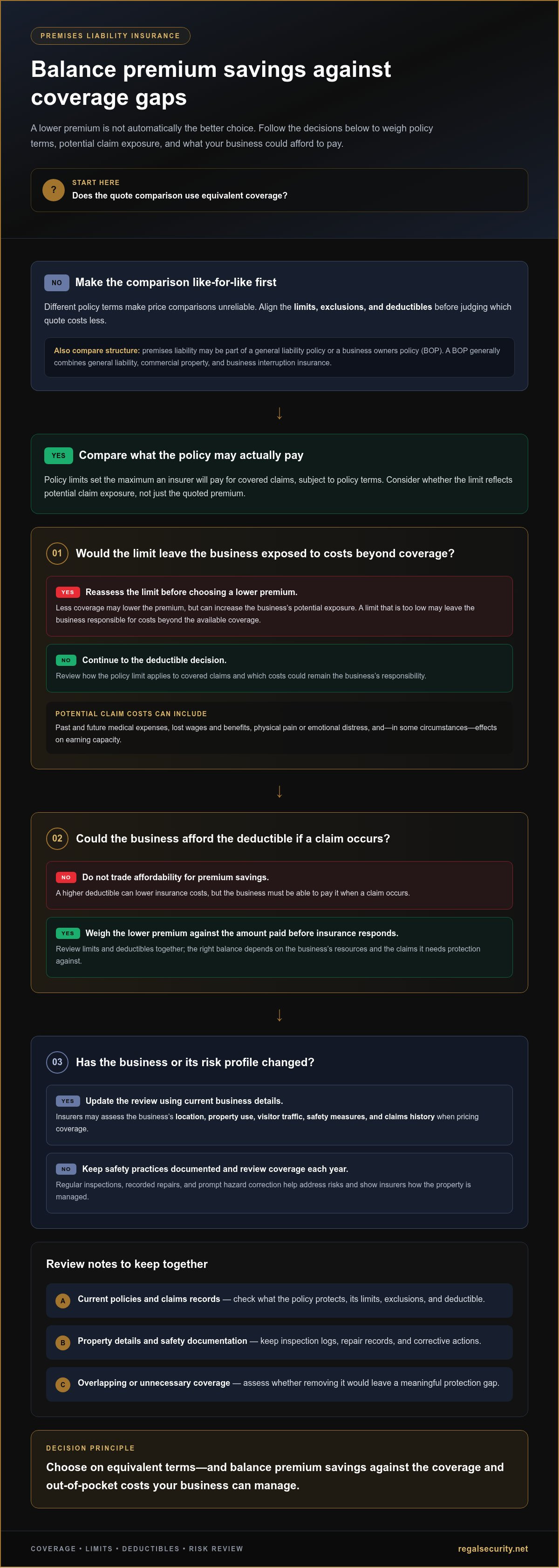
Policy limits set the maximum an insurer will pay for covered claims, subject to the policy’s terms. A limit that is too low may leave a business responsible for costs beyond the available coverage. Higher limits can increase premiums, while less coverage may lower the premium but increase the business’s potential exposure. Deductibles also affect the balance: a higher deductible can lower insurance costs, but the business must be able to pay it when a claim occurs.
Consider a visitor injury involving medical expenses, lost wages, and other damages. The policy limit affects how much the insurer may contribute toward covered losses, while the deductible affects what the business pays before insurance responds. Review both together, rather than treating them as separate savings choices. The right balance depends on the business’s resources and the claims it needs protection against.
When insurance limits are insufficient, the property owner’s coverage and assets can affect the practical amount of compensation available. A business should understand the policy’s maximum payment and how the limit applies to covered claims. Reviewing the terms clarifies what insurance may contribute and which costs could remain the business’s responsibility.
Compensation can include more than immediate medical bills. A premises liability claim may involve past and future medical expenses, lost wages and benefits, and physical pain or emotional distress. Long-term limitations may affect earning capacity. For example, an injury that prevents someone from returning to their former work may involve different losses from an injury requiring only short-term recovery. The circumstances and documented effects shape the claim.
Workers’ compensation is a separate consideration when an employee is injured at work. In most U.S. states, businesses are required to carry workers’ compensation insurance. It addresses employee injuries, while premises liability coverage generally concerns claims involving visitors and property-related hazards. Keeping these forms of protection distinct helps businesses avoid relying on one policy to address a different type of claim.
Correct employee classification matters for workers’ compensation costs. Class codes identify the type of work each employee performs, and incorrect classifications can result in higher premiums. Compare job duties with assigned codes, particularly when responsibilities change. Deliberately misclassifying workers to reduce premiums can leave employees without essential coverage and lead to serious penalties.
For a sound review of limits and deductibles, compare potential claim costs with the business’s ability to absorb expenses. Then check that workers’ compensation classifications reflect employees’ actual duties. These reviews help distinguish appropriate savings from choices that could leave losses uncovered or employees without essential protection.
Choosing a higher deductible
A deductible is the amount a business pays toward a covered claim before insurance responds. Raising it can lower the premium, but shifts more of each covered loss to the business. Consider a shop where a visitor is injured near the entrance: the deductible affects the owner’s initial share, while the policy’s other terms determine the insurer’s contribution. Weigh the premium saving against what the business would need to pay after an accident.
Start with available cash, not an expected premium reduction. Review operating funds, upcoming expenses, and existing obligations, then decide what deductible the business could pay without disrupting essential operations. A higher deductible is practical only when funds are available to meet it. If a claim occurs during a slow period, a payment that seemed manageable earlier could strain cash flow.
Next, compare deductible options using the same policy limits and coverage terms. Changing limits at the same time makes it difficult to tell which adjustment changed the premium. Ask for comparable quotes that vary only by deductible, then record each deductible and its corresponding premium. This makes the tradeoff clear without confusing a lower premium with broader protection.
Consider the business’s claims history and property conditions. Review claims records alongside inspection logs, repair dates, and hazard reports. These details help owners assess how often they might need to pay a deductible, rather than treating the premium as the only relevant figure.
A higher deductible should never replace reasonable precautions. If a loose handrail or wet floor contributes to an injury, prompt repairs and clear warnings remain essential parts of responsible property management. Keep routine safety checks in place and record corrective work. The deductible changes how a covered claim is shared financially; it does not prevent accidents or remove the duty to address known hazards.
Before changing the deductible, follow a simple review: identify the premium difference, confirm the amount due for a covered claim, and assess whether available funds can meet that obligation. Revisit the choice when cash reserves, property use, or claims history changes. A deductible selected for a stable year may not suit a period of expansion or tighter finances. The sound choice balances predictable premium savings with the ability to respond responsibly when an injury claim arises.
Insurer risk assessment and underwriting
Before setting a premium, insurers assess the likelihood and potential severity of claims at a property. They may consider the business’s location, property use, visitor traffic, safety measures, profession, employee count, and claims history. A busy venue with frequent visitors presents a different exposure from an office with limited public access. Insurers also weigh claim frequency and severity, so one costly incident can influence pricing more than several minor claims.
Underwriting considers more than the building itself. A business’s operations help show how visitors use the premises and which hazards may arise. For example, a site with customer queues needs to manage circulation and keep walkways clear. Documented inspections, prompt repairs, and clear incident records help show how the business handles those risks. Accurate information about operations and property conditions gives the insurer greater context for assessing general liability exposure.
Risk-management discounts vary by insurer. Some insurers offer discounts for implementing a safety program or maintaining customer loyalty. A safety program may also help reduce losses and lower workers’ compensation and general liability premiums. The potential value is not limited to a discount: preventing injuries can reduce disruption and claim-related costs.
Businesses can make risk controls easier to assess by keeping records that connect identified hazards with corrective action. Useful evidence may include:
Inspection logs showing when staff examined entrances, floors, stairways, and shared areas.
Repair records documenting the hazard, the work completed, and when access was restored.
Employee training materials explaining how staff report spills, damaged fixtures, or unsafe conditions.
Incident reports recording what happened, where it occurred, and the response taken.
Insurers may also provide risk-control recommendations, such as theft-prevention programs or human resources training, depending on the business’s exposures. Implementing a recommendation and retaining evidence of the change gives the insurer a clear account of the control in place. For example, a written procedure for reporting hazards is more useful when staff are trained and inspection records show that the procedure is followed.
At renewal, compare the insurer’s assessment with current operations. If visitor traffic, building use, staffing, or claims history has changed, provide updated details instead of relying on an older application. Ask which risk factors affect the general liability premium and whether documented improvements could influence future underwriting. This focused discussion connects prevention efforts with the insurer’s view of the property’s exposure.
Annual insurance policy reviews
Review business insurance policies annually because operations, property, and visitor activity can change between renewals. A growing company may add a location, expand public access, or change how customers move through its premises. Each change can alter the risks the policy needs to address. Comparing current operations with existing coverage can reveal outdated terms, missing protection, and costs tied to coverage the business no longer needs.
Begin with an up-to-date inventory of locations, activities, employees, equipment, and property values. Compare it with the policy descriptions and insured locations. For example, a business that has stopped using a storage area may need to reassess coverage connected to that operation. Remove coverage only after a careful review, since a past activity might still create exposure or a remaining property risk.
Check insured values against current circumstances. Equipment coverage should reflect depreciated values rather than full market values, while building insurance should reflect the property’s actual worth. If a business continues using original equipment prices after years of use, it may be paying to insure values that no longer match the equipment. Conversely, a building value that does not reflect its actual worth can leave protection misaligned with the property.
Review how policies fit together. Combining business coverages under one policy can be more cost-effective than buying them separately. Ask whether essential coverage could be placed in one package, then compare it with separate policies using equivalent terms. A business owners policy generally bundles general liability, commercial property, and business interruption insurance. Compare the protections included, not just the quoted premium.
Payment arrangements also belong in the annual review. Some insurers offer a reduced rate when a business pays the annual premium upfront. Ask whether paying annually instead of using a payment plan would lower the total premium, then weigh the saving against available operating cash. Preserve funds for payroll, repairs, and other obligations rather than creating avoidable financial strain.
Use a renewal worksheet to make the review consistent from year to year. Record changes in locations, services, staffing, property values, and claims, then note coverage adjustments and their effect on the premium. Compare insurer proposals using similar limits, deductibles, and exclusions. If visitor access or property use changes after renewal, document it for the next review rather than relying on an old description. This record helps owners explain coverage decisions and identify meaningful adjustments without sacrificing protection visitors may depend on.
Regal Security: Unarmed Security Officers
Regal Security provides Unarmed Security Officers for businesses seeking a professional on-site security presence. This service can complement a broader premises safety plan by supporting a visible, attentive environment for employees and visitors. Security personnel do not replace insurance coverage, property maintenance, or prompt hazard repairs, but they can form part of a considered approach to managing on-site safety.
Consider this support when a property’s operations call for an additional security presence alongside documented inspections and clear safety procedures. Regal Security also provides Concierge Services, Vehicle Patrol, and Executive Protection for different security needs. Each service addresses a distinct operational context, so the right fit depends on the environment and the role security should play.
To discuss Unarmed Security Officers for your property, contact Regal Security.
Build a Safer Property Plan From Here
Managing premiums is most effective when insurance decisions accompany practical property safeguards. When considering ways to reduce premises liability insurance costs, treat prevention and coverage as complementary responsibilities: insurance responds to covered claims, while consistent on-site attention can help identify concerns before they escalate. Security support does not replace insurance or property maintenance, but it can contribute to a more considered approach to visitor safety.
For properties that would benefit from a visible security presence, Regal Security provides Unarmed Security Officers, Concierge Services, and Vehicle Patrol. The appropriate option depends on the property’s environment and operational needs. These services can support a broader safety plan while owners review insurance with their agent and address hazards promptly.
To discuss security support for your property, contact Regal Security. Thoughtful planning can help you move forward with greater clarity and care.
Frequently Asked Questions
Does One Claim Automatically Raise Your Premium?
No, a single claim does not automatically increase every policy’s premium. Insurers may consider the incident, payout, property maintenance, possible negligence, and prior claims. For homeowners, a premium may stay the same, rise, or the policy may not be renewed. For a business in New York City or New Jersey, keep a clear record of the incident and corrective actions, then review how the insurer evaluated the claim at renewal.
What does duty of care mean?
Duty of care means taking reasonable steps to maintain a safe environment for people who enter a property. The care owed can depend on a visitor’s status and applicable state law. Businesses generally owe invitees the highest duty, including regular inspections, repairs, and clear warnings. For example, a store should address a known spill and alert visitors while staff arrange cleanup, rather than leave the hazard unattended.
What factors affect premises liability insurance premiums?
Premiums may reflect a business’s location, property use, visitor traffic, profession, employee count, safety measures, and claims history. For example, a high-traffic retail space in Manhattan may present different exposures from a business with limited visitor access in Nassau County. Insurers also weigh claim frequency and severity, so a serious incident can matter more than several minor claims. Policy limits and deductibles also influence the quoted premium.
How can businesses use claims history to lower premises liability premiums?
Use claims history to identify patterns and document changes that address their causes. If reports show repeated falls near an entrance, record when the area was inspected, what repairs followed, and how staff handled later hazards. Insurers weigh both claim frequency and severity, so organized records can help explain risk controls during underwriting. Report incidents accurately: concealing them does not correct the underlying exposure or support sound decisions.
How can businesses compare premises liability insurance quotes and policies?
Compare quotes using the same limits, deductibles, exclusions, and coverage scope. A lower premium may reflect narrower protection, so examine what each policy covers and where restrictions apply. For a business with locations in Brooklyn and New Jersey, compare each location’s details consistently across proposals. Record differences in writing, then assess whether the savings justify any change in protection. Otherwise, the quoted prices may not be comparable.
How often should a business review its premises liability insurance coverage?
Review coverage annually and whenever operations change materially. A new location, expanded public access, changed property use, or shift in visitor patterns can alter the business’s exposure. For example, adding a customer-facing area in Queens may require owners to reassess how their policy describes the premises. Keep a written record of changes and decisions so renewal discussions reflect current conditions, not outdated assumptions.
What risks arise from choosing lower coverage limits to save on premiums?
Lower limits can leave a business responsible for covered losses exceeding the policy’s maximum payment. A serious visitor injury may involve medical expenses, lost wages, and other damages, so the available limit can affect how much insurance contributes. If a policy limit is insufficient, other potential sources may include additional insurance policies, the business’s or property owner’s assets, or claims against other responsible parties. These possibilities do not eliminate the risk of a coverage shortfall.