Measuring ROI on Security Services and Showing Business Value
Security earns its place in the budget when its value is expressed in business terms. Measuring ROI on security services means subtracting total expenses from the benefits, dividing the net return by total expenses, then multiplying by 100. That financial measure matters, but it doesn't capture every benefit: reduced exposure, steadier operations, and greater confidence may also support the case for protection.
Leaders need more than a record of incidents or activity. They need a clear account of how security affects business priorities. It is reasonable to ask whether an investment reduces losses enough to justify its cost, especially when preventing an incident is less visible than responding to one.
This article explains how to assess security services’ effect on losses and risk, communicate their value to executives, and build a sound basis for future investment. Baselines, comparable performance measures, and transparent cost-benefit calculations can turn operational results into a business case leaders can understand. The goal is not to present every benefit as a guaranteed saving, but to show the evidence with care and context.
Table of Contents
Communicating risk reduction to executives and boards
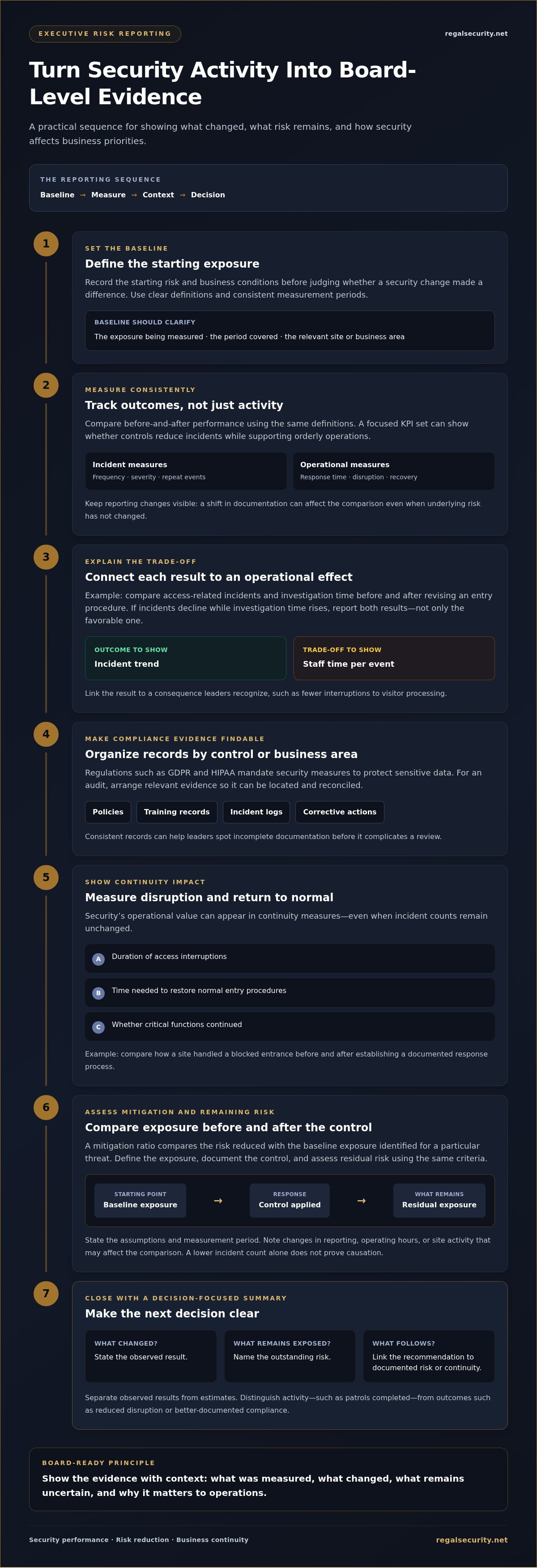
Executives need a concise account of how security changes exposure, operational performance, and business continuity. Present the baseline, measured outcome, and implication for business priorities.
Risk-Reduction and Efficiency KPIs
Risk-reduction and efficiency KPIs compare security exposure and operational performance before and after a change. They help leaders assess whether controls are reducing incidents while supporting orderly operations. Track incident frequency, severity, response time, disruption, and repeat events. Use consistent periods and clear definitions so board members can distinguish a genuine change from a change in reporting.
For example, a facilities team might compare access-related incidents and investigation time before and after revising an entry procedure. Report both the incident trend and the staff time needed to manage each event. If incidents decline while investigation time rises, leaders can see the trade-off rather than a single favorable figure. A concise KPI panel should connect each result to an operational consequence, such as fewer interruptions to visitor processing.
Compliance evidence gives the board another tangible view of risk management. The GDPR and HIPAA are examples of regulations that mandate security measures to protect sensitive data. For an audit, organize relevant policies, training records, incident logs, and corrective actions by control or business area. Consistent records can make it easier to locate and reconcile evidence during an audit. They also help leaders spot incomplete documentation before it complicates a review.
Business continuity measures show whether security supports operations during disruptions. Track the duration of access interruptions, the time needed to restore normal entry procedures, and whether critical functions continued. For example, compare how a site handled a blocked entrance before and after establishing a documented response process. Report operational effects alongside incident counts: less downtime can matter even when recorded incidents remain unchanged.
Mitigation Ratios and Risk Reduction
A mitigation ratio compares the risk reduced with the baseline exposure identified for a particular threat. It helps leaders judge whether a control addresses the risk it is intended to manage. Define the exposure, document the mitigation, and compare the remaining risk using the same criteria. The ratio is meaningful only when its assumptions and measurement period are clear.
For a board presentation, show the starting exposure, the control applied, and the residual exposure in one sequence. For example, if a site identifies unauthorized access as a priority, describe relevant incidents, response measures, and subsequent access findings. A lower incident count alone does not prove causation. Note changes in reporting, operating hours, or site activity that could affect the comparison.
Close with a decision-focused summary: what changed, what remains exposed, and what action follows. Separate observed results from estimates, and link each recommendation to a documented risk or continuity concern. This helps executives assess security performance without confusing activity, such as patrols completed, with outcomes, such as reduced disruption or better-documented compliance.
Should You Be Measuring the ROI of Security Services for Your Business?
ROI analysis helps leaders compare security investment with avoided losses, operational effects, and customer confidence. In the United States, the average data breach cost reached $10.22 million in 2025, making early detection and response financially relevant.
Direct Benefits and Avoided Losses
Direct benefits are measurable savings or losses avoided through earlier detection, effective response, or reduced disruption. They matter because leaders can compare these outcomes with the expense of protection. IBM’s Cost of a Data Breach Report found breaches contained in under 200 days cost about $1.33 million less than breaches that lingered undetected. This illustrates why response speed belongs in an ROI assessment.
To estimate avoided losses, identify a specific event, its likely business impact, and the change associated with a security measure. For example, compare incident records and interruption time across equivalent operating periods. Keep observed savings separate from estimated losses avoided. This prevents a hypothetical event that did not occur from being presented as cash already saved.
Insurance premiums and liability can also affect the calculation. Compare actual renewal premiums across policy periods, accounting for changes in coverage and other underwriting factors. Assess liability using documented claims, legal expenses, and exposure scenarios. Do not treat a possible claim as a realized saving.
Trust and Reputation Benefits
Trust and reputation benefits are indirect business outcomes that security may help preserve, rather than immediate cash savings. They matter because customer confidence can influence retention and revenue. Estimate the revenue impact of a hypothetical 5% increase in customer retention, then label it as a scenario, not a proven effect of security.
Connect reputation measures to business evidence, such as customer complaints, retention patterns, and service interruptions after incidents. For example, compare customer feedback before and after a disruption, while noting other factors that may affect sentiment. This gives executives a more grounded view of trust without assigning an unsupported dollar value to goodwill.
Limits of Security ROI Calculations
Security ROI calculations estimate financial and operational benefits relative to costs. They matter because an overly narrow calculation can undervalue protection or give leaders false confidence. A breach that never occurred has no directly observable cost, so avoided-loss estimates depend on assumptions about likelihood, impact, and control effectiveness.
Use a consistent time period and clearly separate measured outcomes from projections. Avoid counting the same benefit twice, such as treating reduced downtime as both recovered revenue and avoided loss. ROI also cannot fully represent compliance readiness, employee confidence, or continuity. Present these outcomes alongside the calculation, with their evidence and limitations clearly described.
For physical sites, reviewing on-site security support can help connect operational needs with the appropriate protective presence.
Using ROI measurements to support future security investments
ROI metrics help decision-makers compare a security investment with its expected business benefit. Use the results to guide strategy, not simply to justify existing spending.
Investment Frameworks and ROI Formulas
FAIR, the Factor Analysis of Information Risk, frames risk through potential loss frequency and magnitude; Gordon-Loeb helps consider protection spending against expected loss. These frameworks matter because they make assumptions visible. A basic ROI calculation is net return divided by total expenses, multiplied by 100. ROSI compares exposure reduced with solution cost, making its assumptions equally important.
For example, an investment with $25,000 in expenses and $50,000 in benefits produces a $25,000 net return and 100% ROI. That result depends on how benefits are defined. The Gordon-Loeb model suggests optimal cybersecurity investment should not exceed 37% of expected loss. Treat that as a theoretical guide, not a fixed spending rule for every organization.
Threats also change the value of existing controls. A loss-prevention strategy built around a current problem may become outdated as criminal activity adapts. Review incident patterns, operating conditions, and control performance together. If the original risk has shifted, update the investment case rather than relying on the previous period’s figure.
Comparing Security Service ROI
Compare each security service against the risks and outcomes it is intended to address. This helps prevent unrelated benefits from being attributed to one investment. For on-site officers, track relevant incidents, response activity, and operational interruptions. For other types of security controls, use measures suited to their purpose, such as alert handling or control effectiveness.
Use a shared calculation method, but distinct baseline metrics. A guard-related example might compare access incidents across equivalent periods. A cybersecurity analysis might estimate annualized loss before and after a control. Alarm-monitoring results should focus on documented alerts and resulting actions, rather than assuming every alert represents a prevented loss.
Building a Security Business Case
A security business case connects a defined risk, proposed investment, expected benefit, and evaluation method. It helps leaders see what decision the evidence supports. Identify the threat, establish a baseline, estimate avoided loss, include total expenses, and explain the assumptions behind each figure.
Present three outcomes: the expected case, a more cautious case, and the conditions that could change either estimate. For instance, show how a change in incident frequency affects expected loss and the investment’s calculated return. Keep recoveries, avoided losses, and operating benefits distinct to prevent double-counting.
Use the same metrics in reviews that supported approval. Compare actual results with the forecast, document emerging threats, and revise the strategy when circumstances change. A clear record of assumptions, evidence, and outcomes gives leaders a sound basis for renewing, adjusting, or redirecting future security investment.
Evaluating loss-prevention effectiveness
Measuring ROI on security services starts with consistent records from before and after implementation. Compare relevant outcomes, then assess whether the change aligns with the control’s purpose.
Security KPIs and Cost-Effectiveness
Security KPIs connect control performance with the resources used to achieve it. They help organizations judge whether a measure delivers practical operational value. Track incident frequency, losses, response time, and service interruptions alongside the expenses assigned to the control. For example, compare reported theft losses and disruption before and after a prevention measure, using the same definitions and period.
Cost-effectiveness depends on more than a lower loss figure. Include the resources required to maintain the control, then compare them with observed outcomes and estimated losses avoided. Keep cybersecurity measures distinct from physical security measures, since detection, response, and prevention produce different kinds of evidence. If a metric improves while another worsens, report both; a single favorable KPI can hide operational trade-offs.
Effectiveness Metrics
Effectiveness metrics show whether a control changes the likelihood or impact of a defined loss event. They help organizations distinguish activity from results. For example, count completed inspections separately from incidents identified, corrective actions completed, and repeat findings. Evaluate a control against the specific threats it addresses rather than treating its deployment as proof of reduced risk.
Use comparable operating periods and account for changes that affect exposure, such as altered business hours or site activity. Collect pre- and post-implementation data, then review results regularly to identify weak points and make adjustments. A reduction in reported incidents is informative, but consider reporting practices and operational changes too. Otherwise, fewer records may reflect different reporting rather than stronger prevention.
Prevented Losses and Industry Benchmarks
Quantifying prevented losses means estimating likely exposure without the control, then comparing that estimate with actual results and documented changes. A prevented event cannot be recorded as a realized saving. Use incident history, loss severity, and control performance to develop an estimate, and label assumptions clearly. For example, compare a retailer’s recorded fraud losses across equivalent periods while accounting for changes in transactions or reporting.
One commercial-site reference point treats at least 100% as a good security ROI, but no benchmark suits every organization. Compare only businesses or sites with similar exposure, operating conditions, and measurement methods. Use the reference as context, not as a guarantee of performance. Local baselines and repeatable results offer stronger decision support than an industry figure alone.
A loss-prevention strategy designed for a current problem may become outdated as criminal activity adapts. Organizations should review incident patterns and operational results as conditions change. A measure that once reduced losses may need adjustment if the type, timing, or location of incidents shifts. For teams measuring ROI on security services, recording each change and its effect preserves a clear link between action and outcome.
Communicating security value to executives
Executives assess security by its effect on business priorities, not activity alone. A report of patrols completed or incidents logged needs context: what exposure did the work address, what changed, and what decision follows? Use a concise framework that connects risk, operational impact, evidence, and the investment requested. This gives leaders a basis for comparing security with competing business needs.
Begin with an executive concern, such as protecting customer payment operations or maintaining access to a business site. Then quantify the exposure using available incident records, downtime, response demands, or loss estimates. Clearly distinguish observed results from projections. For example, reduced interruptions are an observed operational outcome, while revenue preserved during a hypothetical breach remains an estimate.
Translate operational measures into business consequences. If a site’s access process causes recurring delays, describe how they affect visitor handling, employee productivity, and service continuity. Pair the security measure with a relevant metric, such as interruption frequency or time spent resolving incidents. This shows how the investment supports operations without claiming every improvement resulted from one control.
A board presentation can follow a concise sequence: the business risk, the measure taken, evidence of change, remaining exposure, and the decision required. For example, show how a defined response procedure affected an incident’s operational impact, then identify unresolved risks. Keep assumptions visible. Decision-makers should be able to distinguish documented evidence from estimates without searching through technical reports.
Do not reduce the case to a single ROI figure. A money-only approach can lead to minimal asset protection, while security may also support continuity, compliance, and confidence. Present financial outcomes alongside nonfinancial measures, such as disruption avoided or corrective actions completed. Where a figure depends on assumptions, explain the basis and show how a different estimate would affect the recommendation.
Tailor the summary to the decision at hand. A finance leader may need cost assumptions and calculations; an operations leader may focus on productivity and downtime; a board may prioritize exposure and continuity. Use the same underlying metrics, but lead with the consequence each audience must weigh. A breach scenario, for instance, should connect potential disruption to the business function at risk.
Close with a clear recommendation: continue, adjust, or expand the measure, and explain which evidence supports that choice. If leaders are assessing on-site coverage or executive risk, discuss security priorities as part of the investment review. A decision tied to a defined risk, operational outcome, and review measure is easier to evaluate than a request based only on activity.
Regal Security: Unarmed Security Officers
Regal Security provides Unarmed Security Officers for organizations seeking a visible, professional on-site presence. Assess their contribution against a site’s specific operational goals, such as incident documentation, visitor support, or orderly access procedures.
Where security and hospitality needs overlap, Regal Security’s Concierge Services can support a welcoming, attentive environment. Vehicle Patrol and Executive Protection address different needs, so the appropriate service depends on the risks and operating context. Matching the service to a defined need helps businesses evaluate outcomes clearly instead of relying on activity counts alone.
Contact Regal Security to discuss your security needs and the right next step.
Make Your Next Security Decision With Confidence
Use your next planning cycle to connect security decisions with the business outcomes your organization values most. A disciplined approach to measuring ROI on security services can help refine priorities as risks and operating needs evolve. Set a clear objective, identify the evidence that will inform the decision, and make the review part of ongoing business planning rather than a one-time exercise.
Where a professional on-site presence fits your needs, Regal Security offers Unarmed Security Officers, Concierge Services, and Vehicle Patrol. These services support distinct operational requirements, from a visible security presence to attentive visitor support and mobile patrols.
Contact Regal Security to discuss your security needs and consider a suitable next step. With a thoughtful review and clearly defined priorities, you can move forward with greater clarity.
Frequently Asked Questions
What Is Security ROI?
Security ROI compares the financial return associated with a security measure against its total expenses. Calculate net return by subtracting expenses from the benefits, then divide that net return by expenses and multiply by 100. For example, include documented recoveries and estimated losses avoided, but distinguish estimates from cash actually saved. The result supports a decision; it cannot capture every operational or reputational benefit.
What KPIs prove security ROI to the board?
No single KPI proves security ROI; a relevant group of measures gives the board stronger evidence. Pair financial outcomes, such as documented recoveries, with indicators like incident severity, response time, repeat findings, and business interruption. For a residential property, for example, report access-related incidents alongside disruptions to resident services. Explain how each measure relates to the board’s priorities, and identify operational changes that could affect the comparison.
How do you calculate ROI on security services?
Subtract the total expenses from the measured or estimated benefits, divide the resulting net return by total expenses, then multiply by 100. Include relevant operating expenses and distinguish direct recoveries from losses estimated to have been avoided. For example, if a response measure reduces documented disruption, explain how that outcome was valued and which assumptions were used. Keep projected benefits separate from realized savings so leaders can interpret the result accurately.
What metrics measure the effectiveness of security services?
Choose metrics that match the service’s purpose and the risk being addressed. A site may track incident frequency, severity, response activity, access disruptions, and repeat events. A business focused on continuity might also record interruptions to critical operations and the time needed to resume normal procedures. Compare like with like, and note changes in site activity or incident reporting. Activity counts alone, such as completed rounds, do not establish effectiveness.
What data and time period are needed to evaluate security services ROI?
Gather service expenses, incident and loss records, response documentation, and operational data relevant to the risk. Compare periods with similar business activity and use consistent definitions for incidents, interruptions, and outcomes. For a seasonal retail site, align the comparison with comparable trading periods rather than contrasting a peak season with a quieter one. Preserve the underlying records and note changes in hours, occupancy, or reporting that may influence results.
How do US regulations and local requirements affect security service costs and ROI?
Applicable requirements can shape security procedures, documentation, staffing plans, and related operating expenses, affecting the return calculation. Their relevance depends on the organization, activity, and jurisdiction, so distinguish mandatory costs from optional controls in the analysis. For sites in New York City, Manhattan, Brooklyn, Queens, the Bronx, Staten Island, Long Island, Nassau County, Suffolk County, Westchester County, Rockland County, Orange County, or New Jersey, assess requirements for each location rather than assuming they are identical.