How to Compare Security Company Pricing, Guards and Services in NYC
The lowest quote isn’t necessarily the best fit for a New York City property. Knowing what to look for in a security company in NYC means weighing local experience, appropriate guard options, clear pricing and contract terms, active supervision, and dependable communication alongside the proposed service.
A provider should understand your property’s needs, whether it is a corporate workplace, commercial site, or residence. Compare the coverage plan and service management, not just the hourly rate.
This guide explains how to assess a provider’s experience, compare unarmed officers, concierge services, and vehicle patrol, and review proposals, contracts, supervision, and communication. It also shows why a security plan should reflect the property’s layout, visitor activity, operating hours, and staffing needs, so you can make a considered decision with greater confidence.
Table of Contents
1. What Should I Look for When Hiring a Security Company in NYC?
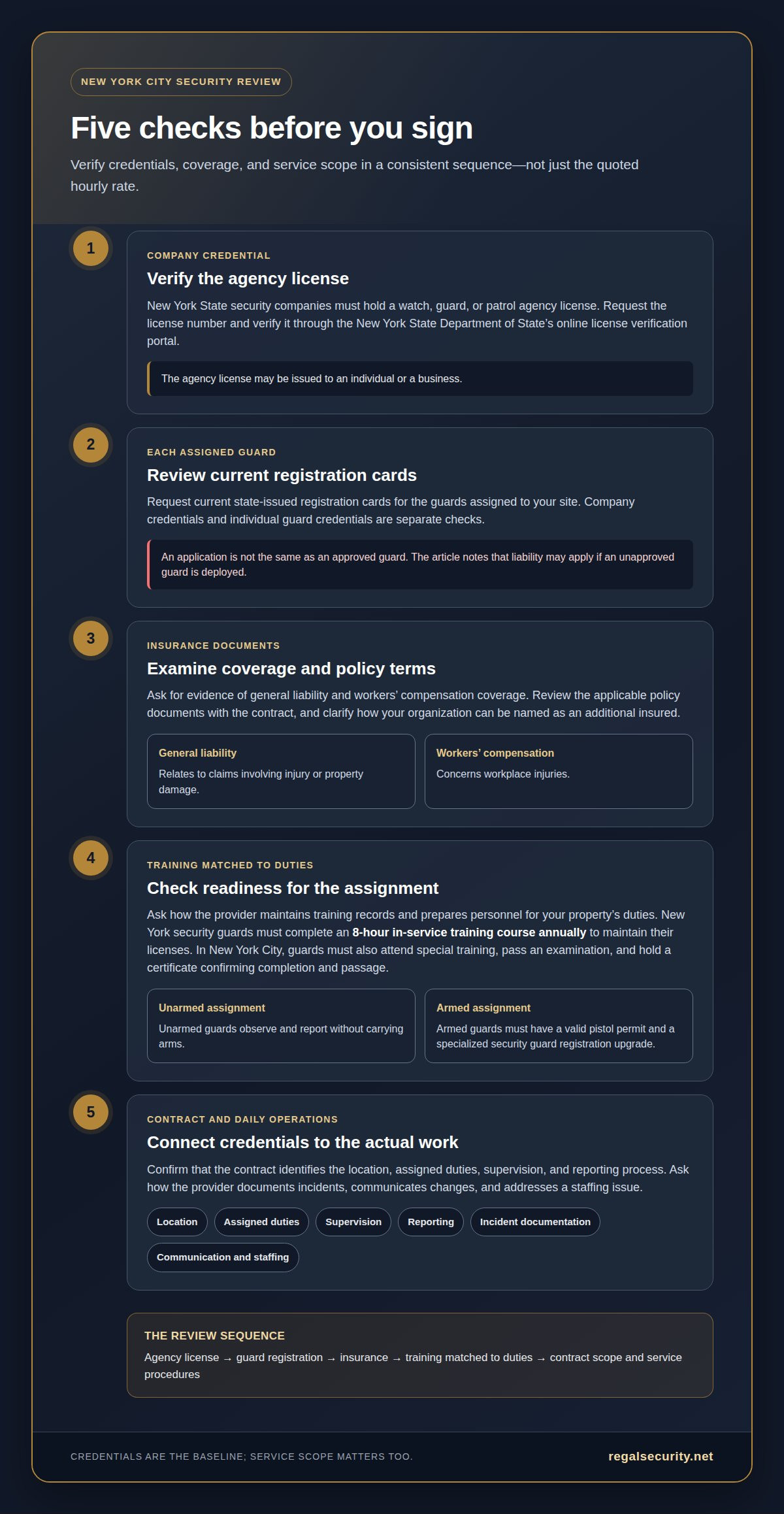
Start with the provider’s New York State license, each guard’s registration, and the insurance protecting your organization. These checks establish a practical baseline before you compare operating plans or discuss a contract. In New York City, company credentials and individual guard credentials are separate matters. A licensed company does not replace the need for properly registered guards.
Security companies operating in New York State must hold a watch, guard, or patrol agency license. Before signing, request the company’s license number and verify it through the New York State Department of State’s online license verification portal. In New York, this agency license can be issued to an individual or a business. Also request current state-issued registration cards for the guards assigned to your site. A guard who has applied for a license is not the same as an approved guard; liability may apply if an unapproved guard is deployed.
Training records provide another concrete measure of readiness. According to the New York State Department of State, New York security guards must complete an 8-hour in-service training course annually to maintain their licenses. According to the New York State Department of State, New York security guards must complete an 8-hour in-service training course annually to maintain their licenses. In New York City, guards must also attend special training, pass an examination, and hold a certificate confirming completion and passage. Ask how the provider maintains training records and prepares personnel for the duties at your property.
Ask for evidence of general liability and workers’ compensation coverage, and clarify how your organization can be named as an additional insured. These protections address different exposures: general liability relates to claims involving injury or property damage, while workers’ compensation concerns workplace injuries. Review the applicable policy documents and contract language together. The provider should explain how coverage relates to its assigned personnel and operations.
The New York State Department of State says New York security guards must complete an 8-hour in-service training course annually to maintain their licenses. Armed guards must have a valid pistol permit and a specialized security guard registration upgrade. Unarmed guards observe and report without carrying arms. The appropriate registration and training therefore depend partly on whether the assignment is armed or unarmed.
Use a consistent review sequence: verify the agency license, review each assigned guard’s current registration card, examine insurance documents, and match training to the proposed duties. For example, a front-desk assignment may require a different emphasis than patrol coverage across a property. Ask how the organization documents incidents, communicates changes, and addresses a staffing issue. Clear answers help you assess compliance as part of daily service, not merely as paperwork at signing.
New York licensing and insurance checks do not replace a careful review of service scope. Confirm that the contract identifies the location, assigned duties, supervision, and reporting process. Those details connect credentials to the actual work. Together, current licensing, suitable coverage, and documented training offer a more reliable basis for evaluating security operations in New York City.
2. Evaluating provider expertise and local experience
Relevant experience is more useful than a broad claim of expertise. A security provider familiar with similar buildings can better understand how entrances, visitor patterns, and daily operations shape coverage. A residential property, for example, has different access needs than a corporate workplace. Knowing what to look for in a security company in NYC starts with asking how past assignments relate to your property type. Look for specific examples of responsibilities handled, challenges encountered, and communication with site management. This helps distinguish practical experience from a general description of services.
References and reviews can add context to a provider’s stated experience. Consider whether feedback describes reliability, professional conduct, and responsiveness when problems arise. Pay attention to how the company responds to critical reviews, not only its positive comments. References from organizations with similar buildings or operations can be especially relevant. Ask about communication during incidents, consistency of staffing, and the process for addressing concerns. These details reveal how service works beyond an initial proposal and help clarify potential liability concerns.
Industry experience should relate to the needs and routines of your site. A provider serving commercial properties may understand visitor access, employee arrivals, and delivery activity. A residential assignment may place greater emphasis on resident interaction and controlled entry. For unarmed coverage, ask how personnel observe activity, communicate concerns, and handle difficult interactions professionally. A useful example explains the situation, the officer’s role, and how information reached the responsible manager. Specific descriptions make it easier to assess whether the experience fits your needs.
Local experience matters because New York City buildings operate within varied neighborhood and property conditions. Ask which boroughs a provider regularly covers and what types of local organizations it serves. Then discuss how its teams account for your location, building access, operating schedule, and visitor flow. A company familiar with a similar site can explain how its approach adapts to those factors. Borough coverage alone does not demonstrate relevant expertise; the provider should connect local knowledge to your assignment and its procedures.
Use a consistent comparison process for every proposal. Review the provider’s industry track record, relevant references, client feedback, and examples of problem resolution. Ask how supervisors receive site updates and how the company addresses operational changes. When deciding what to look for in a security company in NYC, consider whether past examples resemble your property’s needs. For a focused discussion of unarmed security coverage, consider how officer duties would align with your property’s routines. The strongest fit is supported by relevant experience, clear communication, and a defined understanding of the site.
3. Armed and unarmed guards
The choice between armed and unarmed guards should follow the assignment’s risks and responsibilities. In New York City, armed guards carry licensed firearms, while unarmed guards observe an area and report activity. Start by defining the post’s purpose: controlled entry, visible presence, observation, or response coordination. For a building focused on visitor access, an unarmed role may align with front-desk procedures. A different assessment may apply where documented threats call for armed coverage. The proposed duties should explain the choice, not simply the guard’s title.
Age and screening are important parts of a guard’s qualifications. According to the New York State Department of State, security guard applicants in New York must be at least 18 years old. Applicants must also receive electronic fingerprint clearance through the New York State Division of Criminal Justice Services. A provider’s hiring process should address background checks and how it reviews an applicant’s suitability for assigned duties. Ask how the company handles drug testing and ongoing training. These questions help clarify its personnel standards without treating drug screening as a universal legal requirement.
Armed assignments require additional credentials. In New York, armed security guards must have a valid pistol permit and a specialized security guard registration upgrade. A pistol permit alone does not replace the required registration upgrade. The provider should be able to explain how it assigns qualified personnel to armed posts and keeps credential records current. For unarmed assignments, review the guard’s registration and the duties described in the service plan. Matching credentials to the specific role helps prevent confusion about who may perform each task.
Access-control work also depends on clear conduct and communication. At a residential entrance, for example, an officer may observe arrivals, follow the property’s visitor procedures, and report unusual activity to the designated contact. At a commercial building, the post may involve directing visitors and communicating access concerns to site management. Define who can authorize entry, how exceptions are escalated, and what information reports should include. Specific instructions give officers a consistent framework while preserving the organization’s authority over its premises.
Compare proposed guard roles against the same practical criteria: assigned duties, relevant screening, credentials, training, and incident communication. Ask how a guard responds when a visitor disputes an access decision or when an incident requires management’s attention. For armed coverage, include the required permit and registration upgrade in the review. For an unarmed post, focus on observation, reporting, and professional interaction. A provider’s explanation should connect personnel qualifications to the actual building, its access procedures, and the risks identified for that assignment.
4. Contracts, pricing, supervision, and ongoing communication
A useful proposal makes the work measurable before service begins. It should identify the property, coverage scope, guard duties, supervision, and reporting procedures. For example, a proposal for an office building can specify which entrances are covered and how incidents reach building management. Compare each proposal on those terms, not solely on its hourly rate. Professional security depends on clear responsibilities as well as staffing. A reputable provider should explain how its plan reflects your operations and what changes require written approval.
Ask how the provider screens and prepares personnel, including background checks, drug testing, and ongoing training. Clarify who supervises assigned guards, how callouts are covered, and how site concerns are escalated. NYC security companies handle these matters through their hiring processes, supervision arrangements, and incident-reporting procedures. Ask what the process includes and how managers receive reports. For example, an incident report should record what occurred, when it happened, and how staff responded. These details make follow-up more consistent.
Agree on a communication path before an incident occurs. Name the site contact, the provider contact, and the method for urgent updates. The contract or operating plan should explain how officers report routine observations, access concerns, and incidents requiring management’s attention. For events, clarify who receives updates and how changes to the assignment are communicated. A concise activity report can help a property manager track recurring issues. Confirm whether reports are written, shared digitally, or delivered through another agreed process.
Technology can support communication, but the proposal should describe its purpose. Ask whether guards use digital incident reporting, whether daily activity reports are available online, and whether patrol routes are GPS-tracked. Each tool should connect to a clear operational need. For example, a timestamped report can help managers understand when an event occurred, while route records can document patrol activity. Discuss how information is reviewed, who can access it, and how urgent incidents are escalated. Technology should complement professional judgment, not obscure who is responsible for response.
Review contract terms alongside the service plan. Pay particular attention to automatic renewal, cancellation, termination, liability limitations, and escalation procedures. The price depends on the assignment and is provided after a quote request; key factors include coverage scope, staffing, schedule, supervision, and reporting needs. Ask how additional coverage or changes to site operations affect the written scope. A clear change process helps prevent disagreements about duties or charges. Before signing, confirm that the contract, proposal, and reporting expectations describe the same service.
5. Corporate, commercial, and residential security
A security plan should reflect the property, not simply its industry label. A corporate office, retail space, and residential building have different entrances, visitor patterns, operating hours, and staffing needs. The provider should assess those conditions and develop a plan around them. For example, a corporate workplace may need attention at employee and visitor entrances, while a residential property may prioritize resident access and guest procedures. Connecting site conditions to coverage is central to choosing a security partner.
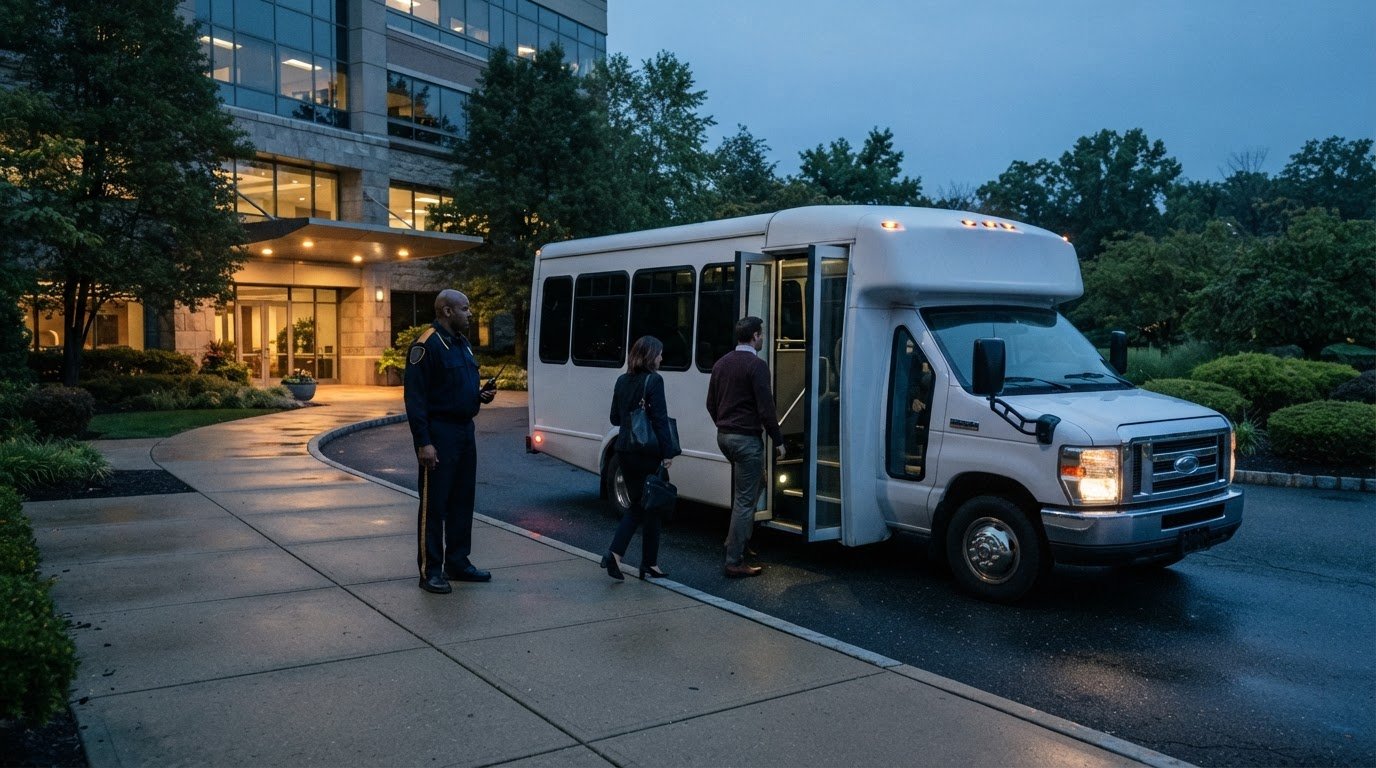
Corporate properties often combine public-facing reception areas with controlled workspaces. A plan can distinguish visitor access from employee movement and specify how officers communicate concerns to building management. Consider a lobby where deliveries, scheduled guests, and staff arrive through the same entrance. The coverage plan should clarify how each group is handled and who resolves access questions. A professional presence should support orderly operations and help employees and visitors feel welcome, without creating unnecessary friction at the entrance.
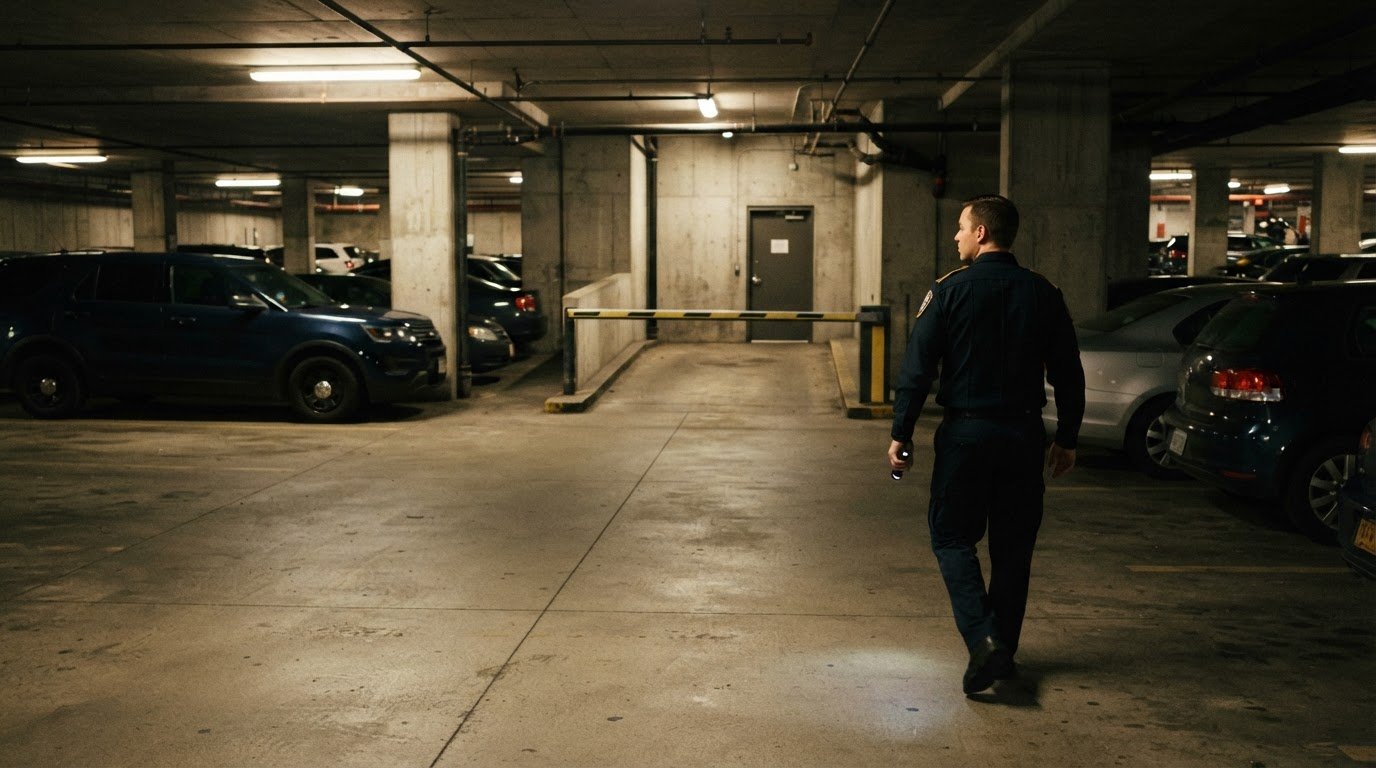
Commercial sites require attention to customer activity, deliveries, and the property’s layout. A retail business, for instance, may need coverage that accounts for public entrances and busy periods. A commercial facility with parking areas may have different visibility needs from a compact storefront. Prior incidents, operating hours, entrances, exits, and staffing needs also shape the plan. Unarmed officers can observe activity and report concerns; the assignment should define how those reports reach site management. Clear duties connect coverage to actual business operations.
Residential security places particular emphasis on residents, guests, and consistent access procedures. A building’s entrance may serve residents, visitors, and service personnel throughout the day. The provider should understand how the property manages those groups and how officers communicate with residents respectfully. For a residential community with parking areas or shared spaces, the assessment should also consider which locations need attention. A measured, courteous presence can support peace of mind while respecting the property’s established routines.
Compare plans by asking how each provider assessed the property and connected its recommendations to specific conditions. Look for a clear explanation of entrances, visitor traffic, operating hours, prior incidents, and staffing needs. Armed guards are not automatically the right choice for every property; the proposed role should align with the identified risks and responsibilities. If your building needs a composed on-site presence, discuss unarmed security coverage tailored to its routines. The strongest plan makes clear who is covered, where attention is focused, and how concerns are communicated.
Regal Security
Regal Security helps organizations align security coverage with their property, operating needs, and expectations for a professional on-site presence. Its services include Unarmed Security Officers, Concierge Services, Vehicle Patrol, and Executive Protection. These options can support different needs, from a welcoming entry experience to visible patrols or discreet protection for an executive. The right fit depends on the setting and the responsibilities required, not simply the service name. Share the property type, access patterns, operating hours, and priorities to support a focused discussion about coverage. To discuss security needs for your organization, contact Regal Security.
Turn Your Priorities Into a Clear Security Plan
The next step is to discuss your property’s needs with a provider. Consider which areas need attention, how people move through the space, and what a dependable on-site presence should accomplish. Sharing those priorities helps shape a service plan around real operations rather than assumptions. It also provides a practical basis for discussing responsibilities, communication, and support for staff, residents, or visitors.
Understanding what to look for in a security company in NYC is ultimately about finding a fit between your needs and a provider’s approach. The right discussion should leave you with a clearer view of the proposed coverage and how it would work at your location. For a professional conversation about your requirements, contact Regal Security. A considered next step can bring greater clarity to your security planning.
Frequently Asked Questions
What Should I Look for When Hiring a Security Company in NYC?
Look for a provider whose credentials, experience, staffing plan, and communication practices fit your property. For example, a residential building with frequent guest access may need a different approach than a commercial office with scheduled deliveries. Compare proposals by duties, coverage, supervision, reporting, and contract terms, not price alone. Also consider whether the provider explains how the plan can adapt when building operations or access procedures change.
How can I verify a NYC security company's licenses, insurance, and business history?
Request the agency license number, then use the New York State Department of State’s online license verification portal. Ask for current registration cards for assigned guards and documentation of general liability and workers’ compensation coverage. To assess business history, review relevant client references and feedback, focusing on reliability and how concerns were handled. Keep the license details, insurance documents, references, proposal, and signed contract together for your organization’s records.
What training and credentials should NYC security guards have?
New York security guard applicants must be at least 18 years old, according to the New York State Department of State. The department also requires an 8-hour pre-assignment course and an 8-hour in-service course annually to maintain licenses. In New York City, guards must attend special training, pass an examination, and hold a completion certificate. Armed assignments require a valid pistol permit and a specialized registration upgrade.
What types of security services do NYC companies offer for residential, commercial, and event needs?
Regal Security provides Unarmed Security Officers, Concierge Services, Vehicle Patrol, and Executive Protection. Residential properties may prioritize entry and visitor procedures; commercial sites may need an on-site presence or patrols. Event organizers should define access, crowd movement, and coordination needs in their plan. Regal Security serves New York City and New Jersey, including Manhattan, Brooklyn, Queens, the Bronx, Staten Island, Long Island, Nassau County, Suffolk County, Westchester County, Rockland County, and Orange County.
How much do security guard services cost in New York City per hour or per shift?
Security service pricing depends on the assignment and is provided after a quote request. Relevant factors include the property type, coverage scope, schedule, staffing requirements, supervision, and reporting needs. An hourly or per-shift figure alone may not reflect the full service being proposed. Compare quotes by matching the duties and coverage described, then consider whether each proposal includes the operational details your site requires.
What questions should I ask when comparing security companies in NYC?
Ask how the provider tailors duties to your property, assigns and supervises officers, and communicates incidents. Clarify who receives reports, how concerns are escalated, and how changes to the assignment are handled. For a building with visitor access, ask how officers follow its entry procedures. For a property with parking areas, ask how patrol coverage is documented. These answers help show whether the proposed service fits your operations.
What red flags should I watch for when hiring a security company in New York City?
Be cautious of proposals that leave guard duties, coverage boundaries, supervision, or incident reporting unclear. Other warning signs include difficulty explaining license and insurance documentation, vague answers about assigned personnel, or contract terms that do not match the proposal. For example, if a quote describes lobby coverage but omits responsibility for visitor procedures, seek clarity in the written scope before signing. Clear documentation supports informed decisions and accountability.