The Definitive Guide to High-Rise Security Services in 2026
Updated: Jul 20
A luxury lobby is no longer merely a checkpoint. It's a defining moment of first impression that dictates the long-term success of your vertical community. In the high-stakes environments of New York and New Jersey, property managers often struggle to reconcile the need for rigorous access control with the desire for a seamless, welcoming atmosphere. Relying on outdated models for high-rise security services frequently leads to tenant friction and increased turnover. You recognize that true safety should feel like a stabilizing force rather than an intrusive one.
This guide provides a comprehensive framework for balancing elite protection with the high-tier hospitality your residents expect. By prioritizing the meticulous training of personnel and a deep understanding of evolving NYC and NJ safety codes, you can reduce liability while fostering a sense of profound peace of mind. We'll examine how a blend of concierge-level care and professional stewardship creates a secure environment that enhances, rather than hinders, the prestige of your development.
Table of Contents
The Evolution of High-Rise Security Services: Beyond the Lobby Desk
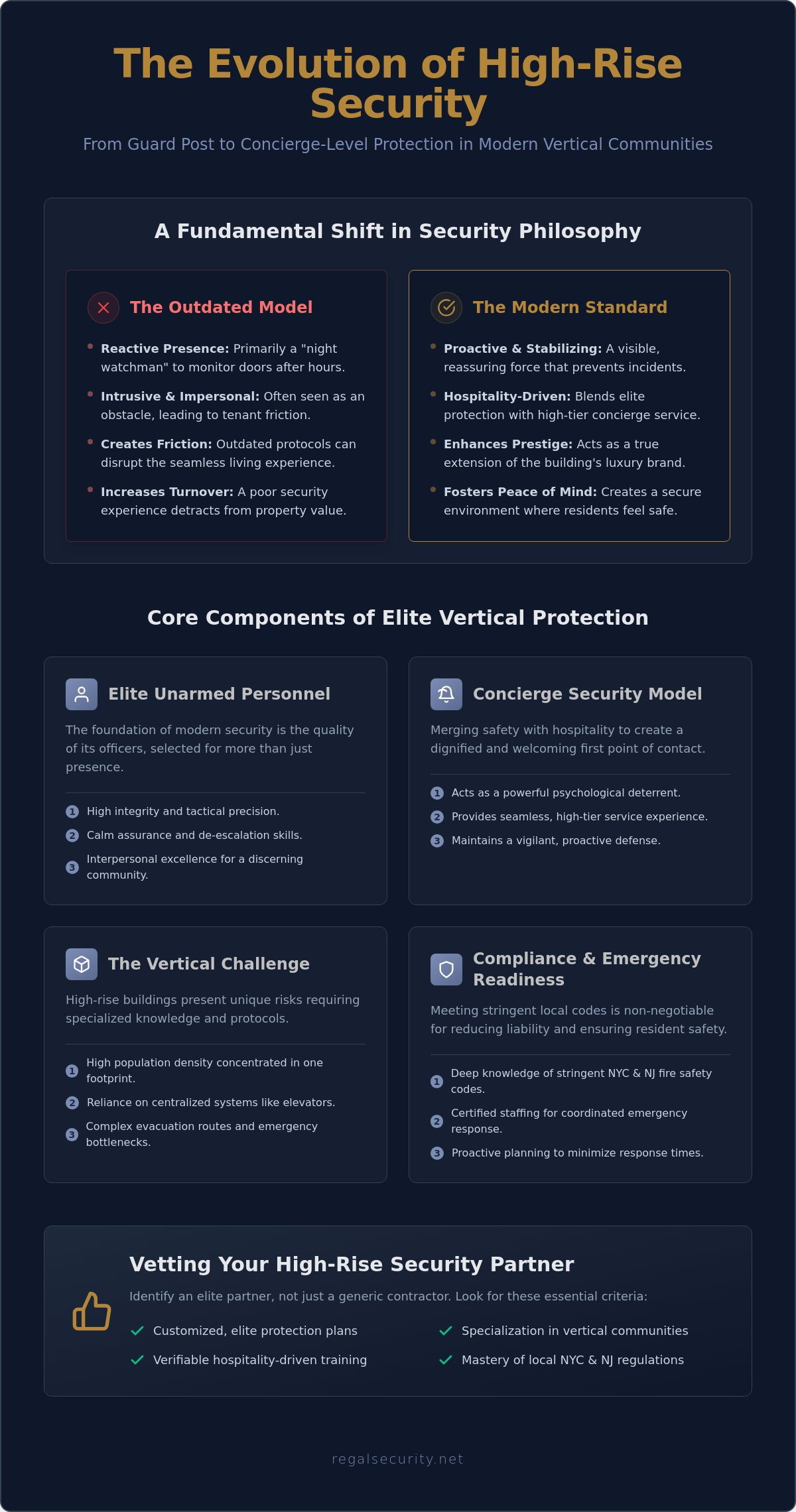
The concept of protecting a vertical asset has undergone a profound transformation. In the past, building safety was often relegated to a "night watchman" role, a reactive presence primarily intended to monitor doors after hours. Today, the complexities of metropolitan living in the New York and New Jersey areas demand a more sophisticated approach. Modern high-rise security services have evolved into a proactive, stabilizing force that blends technical precision with the high-tier service expected in luxury developments. This shift reflects a deeper understanding that a security professional is the first and most frequent point of contact for residents and guests alike.
Vertical communities present a unique set of variables that differ significantly from sprawling corporate campuses. While a horizontal campus might focus on perimeter fencing and wide-area patrols, a high-rise requires a concentrated focus on internal flow and access point integrity. The social and operational dynamics of a hundred-story tower are intricate. Effective protection in these environments is not merely about presence; it is about the quiet strength required to manage high-traffic lobbies while maintaining a welcoming, prestigious atmosphere for those who call the building home.
The Vertical Challenge: Density and Risk
The architectural nature of high-density metropolitan areas creates specific vulnerabilities. High-rise structures rely heavily on centralized systems, particularly elevators and complex stairwell networks, which can become bottlenecks during emergencies. Understanding the fundamentals of skyscraper design and construction is essential for any security team, as it informs how they manage multi-point entry and evacuation protocols. In Manhattan and Jersey City, where vertical density is at its highest, the presence of a professional on-site team is critical for navigating these risks. A well-trained team ensures that emergency response times are minimized and that resident safety remains uncompromised, even in the most challenging scenarios.
Defining the Modern High-Rise Security Officer
The industry is increasingly moving toward the use of unarmed security officers as the gold standard for residential and corporate towers. These professionals are selected for their integrity, precision, and ability to project a sense of calm assurance under pressure. They don't just stand guard; they serve as a reassuring partner to the building's management and its residents. High-rise security services represent a specialized discipline that requires an acute level of tactical awareness combined with the interpersonal excellence necessary to serve a discerning vertical community. By focusing on these high-caliber traits, property owners can ensure their security personnel act as a true extension of their brand's commitment to excellence and safety.
The Concierge Security Model: Merging Safety with Hospitality
The lobby of a premier residential or commercial tower serves as the building’s nervous system. It’s here that the philosophy of high-rise security services is most tangible. A concierge security model doesn't view safety and hospitality as competing interests. Instead, it recognizes that a dignified, uniformed presence acts as a powerful psychological deterrent to unauthorized entrants while simultaneously providing a sense of stability for those who belong. This dual role requires a professional who can pivot seamlessly between enforcing strict protocols and offering a high-tier service experience. They act as the primary filter, ensuring that the sanctuary of the vertical community remains uncompromised.
Balancing the persona of a prestigious guardian with a helpful, service-oriented delivery is a delicate art. It requires a commitment to duty that goes beyond traditional guarding. When an officer greets a resident by name while simultaneously scanning the perimeter for anomalies, they're providing a gold-standard level of care. This methodical approach ensures that security is felt as a reassuring constant rather than a reactive intrusion. By maintaining this high standard, security personnel become an integral part of the building's value proposition, contributing directly to the peace of mind of every occupant.
First Impressions and Access Management
Effective access management in a busy Manhattan or Jersey City lobby requires a blend of technical precision and social grace. The front desk security officer must screen every visitor and vendor without disrupting the natural flow of the environment. This involves maintaining a high register of etiquette while verifying credentials and managing complex delivery logistics. When these interactions are handled with professional assurance, they reinforce the building's prestige. Meticulous attention to detail during the initial point of contact ensures that only authorized individuals proceed to the elevators, which is a fundamental component of modern High-Rise Security risk assessments.
Building Trust Through Professional Assurance
In neighborhoods like Brooklyn Heights or Long Island City, residents value a security presence that projects quiet strength. This personality trait is characterized by a methodical communication style that can de-escalate potential conflicts before they arise. It’s about being a stabilizing force that residents can rely on at any hour. When a professional officer handles a noise complaint or a sensitive entry issue with integrity, they build a foundation of trust that defines the resident experience.
There's a direct, measurable correlation between this level of professional lobby management and concierge security resident retention. When people feel both safe and respected, they're far more likely to remain in their vertical community for the long term. If you're seeking to elevate the atmosphere of your property, integrating professional concierge services is a strategic step toward long-term stability.
Technical Components of Vertical Asset Protection
Protecting a vertical asset requires more than a physical presence; it demands a seamless integration of human intuition and technical infrastructure. While the concierge provides the social interface for the building, the technical framework ensures that every floor, from the sub-basement to the penthouse terrace, remains under meticulous watch. High-rise security services in 2026 are defined by this synergy, where professional officers act as active managers of a building's digital and physical access points. This approach transforms security from a reactive function into a proactive shield that covers every vertical zone of the property.
Unlike horizontal corporate campuses that rely on wide-perimeter visibility, vertical structures require precision-based patrol routes that account for dozens of elevation changes. Security personnel must monitor critical blind spots that are often overlooked in standard guarding models, such as emergency stairwells, mechanical floors, and secluded rooftop amenities. For multi-building developments or those with sprawling underground parking structures, vehicle patrol security services provide an essential mobile layer of protection. This ensures that the transition from the street or parking level to the lobby is as secure and orderly as the residence itself.
Access Control and Elevator Logistics
Managing the flow of individuals in mixed-use developments presents a unique logistical challenge. These buildings often house overlapping residential, commercial, and retail zones, each requiring distinct levels of clearance and access protocols. Security teams must implement strategies that secure loading docks and service elevators without causing friction in daily building operations. This is especially vital when coordinating with executive protection details or verifying the credentials of high-profile individuals. A methodical approach to credentialing ensures the privacy of residents is maintained while allowing vendors and staff to perform their duties with minimal disruption.
Monitoring and Surveillance Integration
Modern surveillance systems are only as effective as the professionals who interpret the data. In a high-traffic metropolitan tower, professional officers augment CCTV networks by providing real-time, on-site judgment that an algorithm cannot replicate. During peak commute times, when lobbies and elevator banks are at their busiest, the security team maintains a steady, logical rhythm of monitoring to detect anomalies before they escalate. This human element remains the building's primary stabilizing force during technical outages or system failures. When digital systems are compromised, the presence of a composed, well-trained officer ensures that manual access protocols are executed with precision, maintaining the continuity of safety without causing alarm.
Compliance and Emergency Response in NYC and New Jersey
The efficacy of high-rise security services is fundamentally measured by their adherence to the stringent regulations that govern the New York and New Jersey metropolitan areas. Operating a vertical community in this region requires more than just a presence; it necessitates an intimate understanding of evolving safety mandates. In New York City, the legacy of Local Law 5 and the current requirements for Fire and Life Safety Directors dictate specific staffing levels and training standards. These aren't merely administrative hurdles but essential components of a proactive defense strategy. By ensuring that every officer is well-versed in these codes, property managers can significantly reduce liability while providing a gold-standard level of care for their tenants.
Coordination with local authorities is a critical, ongoing duty for any professional security team. During high-rise emergency drills, the security staff acts as the vital link between building occupants and the FDNY or New Jersey fire departments. This relationship is built on a foundation of mutual respect and meticulous preparation. Whether managing a large-scale evacuation or executing a "shelter-in-place" order, the security team’s ability to remain methodical and composed ensures that safety protocols are followed without panic. All personnel must be rigorously vetted, ensuring they hold active New York state licensing or are registered under the Security Officer Registration Act (SORA) in New Jersey, which requires passing a background check and completing specialized training.
Local Regulatory Landscape
Navigating the specific ordinances of different NYC boroughs requires a partner who understands that a tower in Manhattan operates under different social and legal pressures than one in Queens or the Bronx. This regional expertise extends to Westchester and Nassau County, where local fire codes and security requirements often vary. Security staffing services must adapt to these nuances, ensuring that all documentation and reporting are meticulously maintained for annual building inspections. This level of precision prevents costly compliance failures and reinforces the building's reputation for integrity and safety.
Emergency Preparedness and Crisis Management
Professional high-rise security officers serve as the primary coordinators between building occupants and first responders during a fire or medical emergency. Their role is to provide a stabilizing presence that guides residents through a methodical crisis communication plan. By keeping tenants calm and informed, the security team prevents the chaos that often accompanies high-pressure situations. This requires a partner with "quiet confidence" who can make split-second decisions with professional assurance. If your property requires a partner who deeply understands these metropolitan mandates, consider our specialized unarmed security officers for your compliance needs.
Selecting a High-Rise Security Partner for Long-Term Stability
The selection of a security partner for a vertical community is a decision that resonates far beyond the lobby doors. It is a commitment to the long-term financial health and social stability of the property. Many agencies offer generic guarding contracts that fail to recognize the intricate social dynamics and technical demands of a 60-story tower. Choosing high-rise security services requires a focus on specialized experience and a partner who views protection as a stabilizing force rather than a reactive one. This involves moving away from aggressive, alarmist models toward a more dignified, professional approach that respects the prestige of the development.
Customized protection solutions are essential because no two vertical assets are identical. A mixed-use building in Manhattan has different operational pressures than a residential tower in Jersey City. A partner who provides a "one-size-fits-all" contract often overlooks the specific vulnerabilities of your property's vertical zones. By positioning peace of mind security services as a strategic investment, property managers can ensure their security strategy evolves alongside the building's needs, protecting the asset's reputation for years to come.
Vetting for Integrity and Precision
Vetting an agency requires a deep look into their recruitment and retention strategies. You should ask potential partners how they source their personnel and what specific hospitality training they provide. In the modern metropolitan market, an unarmed, high-tier service model often outperforms more aggressive alternatives because it fosters a sense of community trust. The "gold-standard" of care is defined by personnel who possess both tactical awareness and the interpersonal excellence necessary to serve a discerning clientele. Key criteria for evaluation include:
Evidence of specialized experience in high-density metropolitan high-rises.
Rigorous background checks and adherence to NY/NJ state licensing.
A proven track record of low personnel turnover to ensure site-specific knowledge.
Training programs that emphasize de-escalation and professional etiquette.
Transitioning to Regal Security
Regal Security delivers customized protection that is meticulously tailored to the unique needs of NYC and NJ towers. We understand the delicate balance required to provide elite protection while maintaining the superior hospitality that residents expect. Our approach bridges the gap between a security force and a concierge service, creating a seamless experience for tenants and guests alike. We don't rely on generic templates; instead, we build a strategy rooted in professional assurance and quiet strength. If you're looking for a partner dedicated to the success and safety of your property, contact our team for a meticulous risk assessment of your vertical assets.
Elevating the Standard of Vertical Stewardship
The transition toward a sophisticated, hospitality-driven approach is no longer a luxury; it's a fundamental requirement for the preservation of premier assets. By integrating technical precision with a dignified lobby presence, property managers ensure their vertical communities remain both safe and prestigious. Navigating the intricate regulatory landscape of the New York and New Jersey metropolitan areas requires a partner who treats compliance as a matter of duty. Our approach to high-rise security services provides the quiet strength and professional assurance necessary to protect your residents while enhancing the reputation of your development.
Regal Security offers a stabilizing force through professional unarmed security officers who possess elite hospitality training and a deep understanding of NYC and NJ safety mandates. We're dedicated to providing a gold-standard level of care that fosters long-term resident retention and operational excellence. Secure your high-rise with Regal Security’s professional concierge and protection services today. We look forward to helping you build a safer, more resilient vertical community.
Frequently Asked Questions
What is the difference between a standard security guard and a concierge security officer?
A concierge security officer provides a seamless blend of elite protection and high-tier hospitality, whereas a standard guard often fulfills a purely reactive role. Concierge personnel act as the primary face of the building, greeting residents and managing deliveries while maintaining a vigilant watch over access points. This hybrid approach ensures that the lobby remains a welcoming environment without compromising the rigorous standards required of modern high-rise security services.
Do high-rise buildings in NYC require specific fire safety certifications for security staff?
Yes, high-rise buildings in NYC must adhere to specific mandates, including the requirement for Fire and Life Safety (FLS) Directors as dictated by the FDNY. These certifications ensure that security staff are prepared to manage complex evacuation protocols and coordinate with first responders during an emergency. Compliance with these local laws is essential for reducing liability and ensuring the building's operational integrity meets metropolitan standards.
How does unarmed security effectively deter threats in a high-rise environment?
Unarmed security effectively deters threats by projecting a dignified, uniformed presence that signals a high level of vigilance and order. Most intruders are deterred by the psychological impact of being observed and the implementation of strict access control protocols. By maintaining a composed and methodical posture, these officers prevent incidents through proactive engagement rather than reactive force, fostering a sanctuary-like atmosphere for residents.
Can high-rise security services help with resident retention in luxury apartments?
Professional security services are a direct driver of resident retention because they provide the stability and peace of mind luxury tenants expect. When residents feel their safety is managed by a prestigious guardian who understands their lifestyle, they develop a deeper sense of loyalty to the property. This consistent, high-caliber care reduces tenant turnover and enhances the overall value of the vertical community.
What technical systems should be integrated with on-site security personnel?
On-site personnel should be integrated with advanced access control systems, elevator destination dispatch technology, and mobile monitoring platforms. These digital tools allow officers to manage the complex flow of mixed-use buildings with greater precision. For example, a digital ecosystem like MyGatePass can streamline visitor management through dedicated apps for security and guests. While technology provides the data, the security professional provides the real-time judgment necessary to address anomalies that automated systems might overlook.
How does Regal Security handle visitor management for high-profile residents?
We handle visitor management for high-profile residents with a focus on discretion and meticulous credential verification. Every interaction is conducted with a high register of etiquette to ensure the resident's privacy is never compromised. Our team coordinates closely with any existing executive protection details to provide a seamless transition from the street level to the private residence.
Is it better to have static guards or mobile patrols for a high-rise complex?
A truly effective security strategy utilizes a combination of static lobby presence and mobile vehicle patrols to cover every vertical and horizontal zone. Static officers manage the primary access points, while mobile units are essential for securing parking structures and the building's exterior perimeter. This multi-layered approach ensures that no area, from the sub-level to the rooftop, remains unmonitored.
What are the most common security vulnerabilities in vertical developments?
Common vulnerabilities in vertical developments include unmonitored stairwells, mechanical floors, and the complex logistics of service loading docks. These blind spots require precision-based patrol routes to ensure consistent coverage. Additionally, technical outages can create temporary gaps in access control, making the presence of a well-trained, on-site security professional the building's most reliable stabilizing force.


